Practitioners Academy Academy (opens in a new tab) Book a Consultation
HomeSolutionsOT Data Path Review
Solution blueprint

OT Data Path Review

A blueprint for reviewing dashboards, reports, remote access, edge gateways, and cloud visibility without weakening OT security or continuity.

Operating problem

Plants want dashboards, reports, and cloud visibility, but unclear OT data paths can create continuity, security, and recovery risk. The blueprint reviews the route from source system to decision surface before expanding connectivity.

How to read this blueprint Security and topology examples here are generalized reference patterns. Every OT environment carries its own policies, vendor constraints, and approved architecture — adapt the review sequence to yours rather than transplanting the diagrams.
OT Data Path Review blueprint video poster
00:36 visual explainer brief: Show how plants can pursue dashboards and cloud visibility while reviewing source access, trust zones, read-only paths, and recovery discipline.
Symptoms and decision signals

What usually tells the team the problem is real

Direct PLC access pressure

Dashboards, vendors, or cloud tools ask for access before read-only paths and ownership are clear.
Unknown gateways

Edge devices, remote access tools, or vendor bridges exist without a current trust-zone or recovery record.

Weak backup confidence

PLC, HMI, gateway, or network backups exist but are not tested or tied to a recovery plan.

IT and OT speak past each other

Security goals and production-continuity constraints are discussed as separate priorities.
Why common approaches fail

Useful technology fails when the operating decision is undefined

IT-only security review The review applies generic IT controls without mapping plant operations, recovery needs, or vendor realities.
Vendor sprawl Each machine, dashboard, or remote-support provider creates a separate data path and support burden.
Direct reads without governance Dashboards or scripts read directly from PLCs, databases, or engineering stations without clear risk boundaries.
No recovery test Connectivity is added without confirming backups, rollback, or restoration procedure.
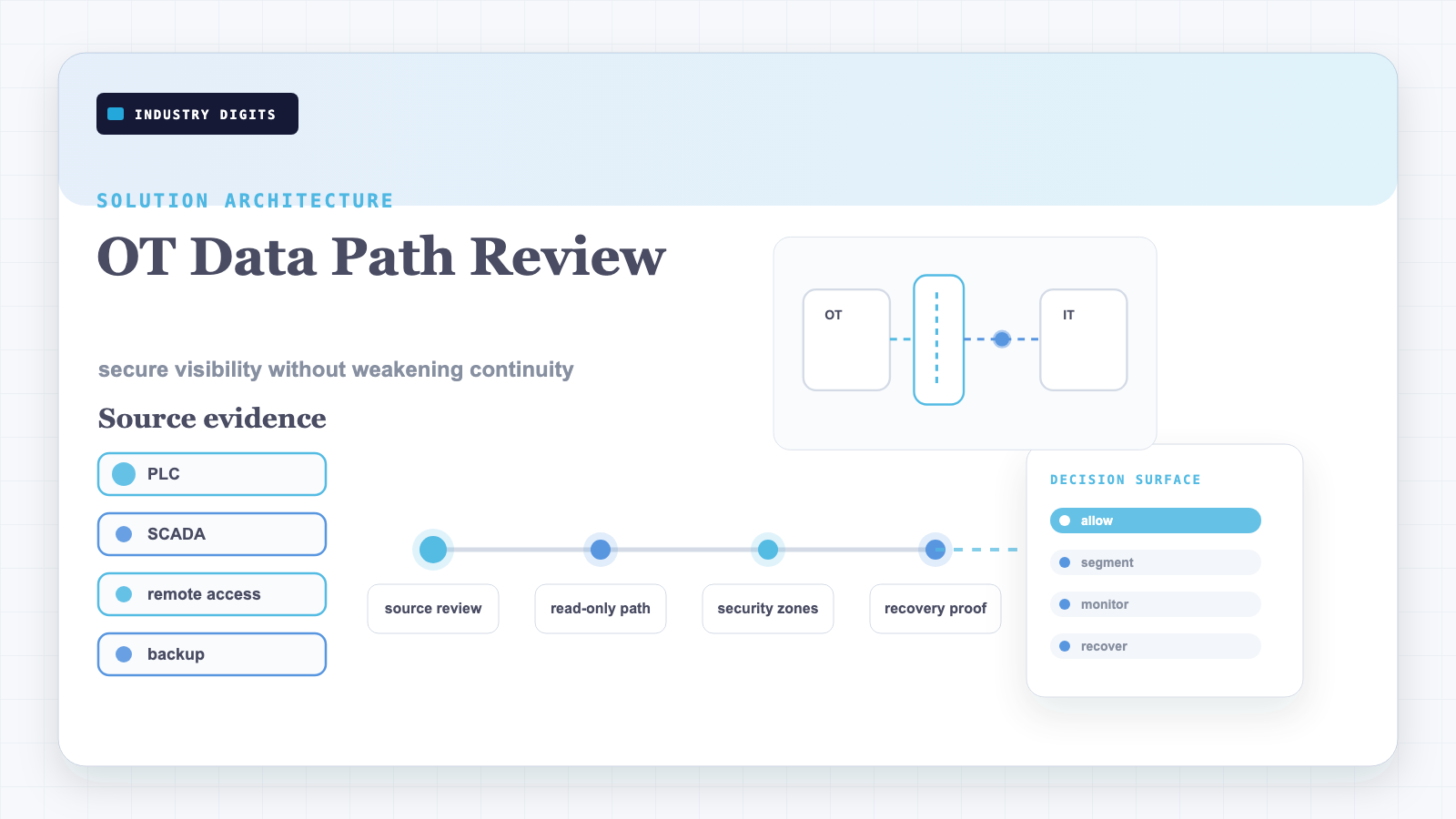
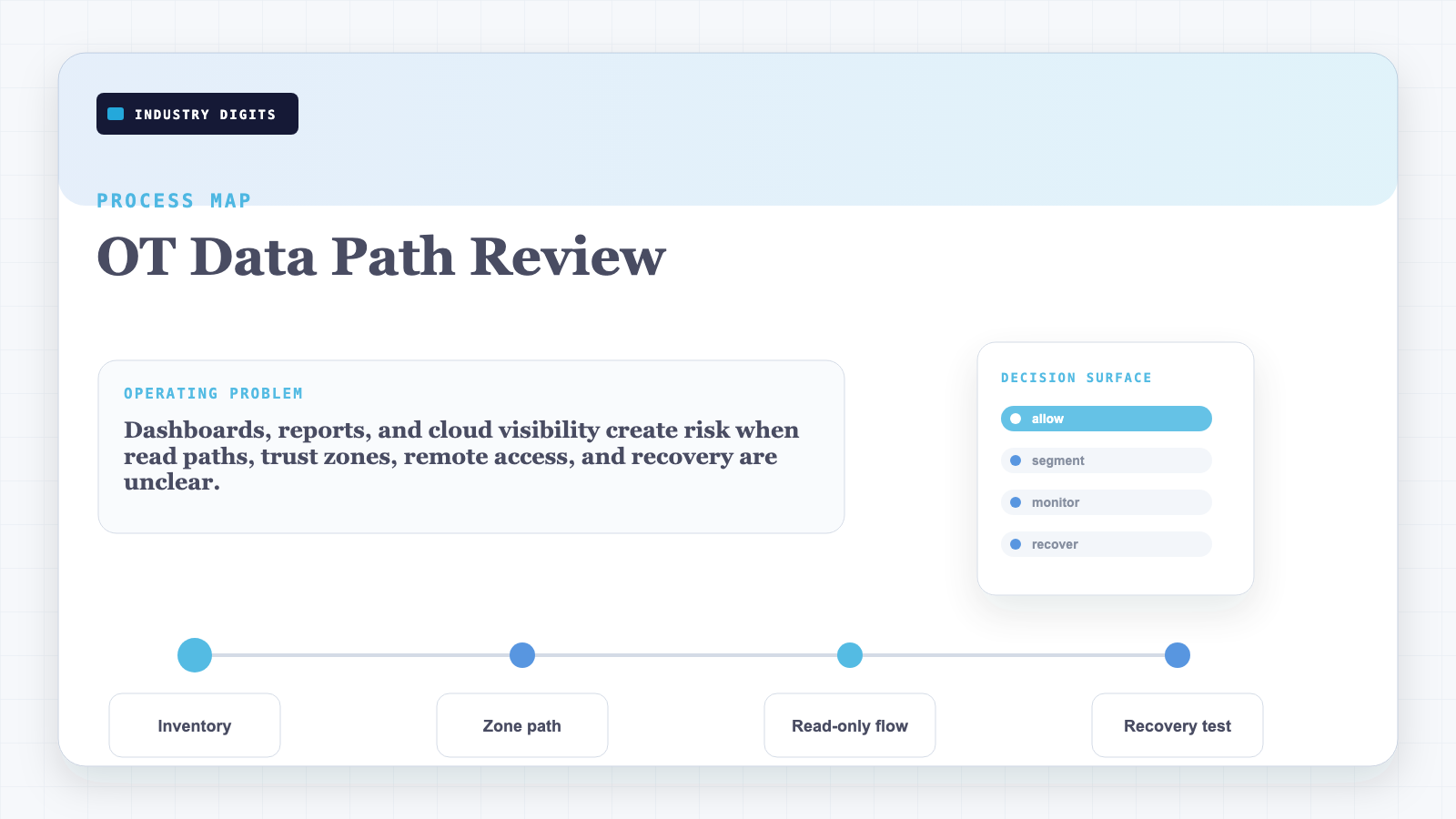
OT data path review process map from source inventory to read-only path, security zone, and recovery proof
Process map: how the issue moves from signal evidence to review and action.
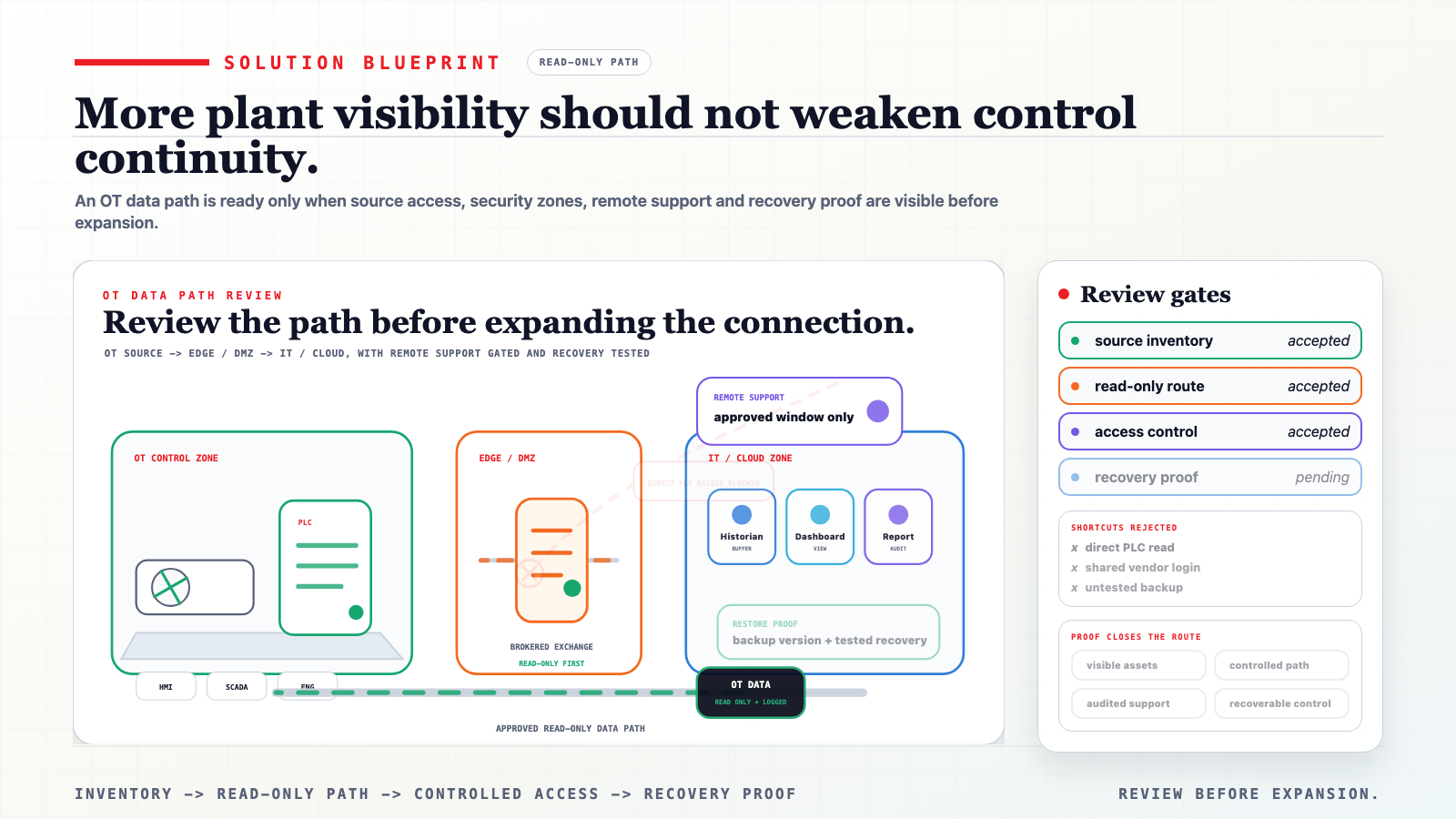
OT data path review architecture showing PLC, SCADA, historian, edge gateway, security zones, dashboard, and backup review
Architecture view: sources, data path, decision surface, and owner-backed action.
Solution architecture

What has to connect before scaling

OT source review Identify PLCs, SCADA, historians, engineering stations, gateways, vendor systems, and existing data consumers.
Read-only path Define acceptable read-only routes, broker or historian boundaries, and access ownership.
Security zones Map OT, edge, DMZ, IT, cloud, and remote support zones with traffic direction and responsibility.
Backup and recovery Review configuration backups, restore tests, owner sign-off, and recovery steps before expanding data access.
30 / 60 / 90 day path

A release path that earns trust before scale

These stages are planning ranges. The real cadence depends on plant access, signal quality, risk, and ownership.

30 days

Inventory data paths

Map source systems, existing gateways, remote access tools, dashboards, and backup status for one plant area.

60 days

Define governed read path

Agree source ownership, read-only access pattern, security zone boundary, and first data contract.

90 days

Test recovery and standardize

Validate backup or rollback steps, document the data path standard, and decide which future connections are allowed.

Required signals

The data contract is the practical proof surface.

Each signal needs ownership, unit, context, quality, and review logic. Without that contract, dashboards and alerts become fragile.

Source access Source system, tag set, read method, owner, allowed consumer, and whether access is read-only.
Gateway or broker Device, location, network zone, protocol, buffering behavior, patch or support owner, and failure behavior.
Remote access Vendor or user, purpose, approval path, session method, logging expectation, and revocation process.
Backup and recovery Backup date, owner, restore test status, rollback steps, and dependency list.
Explainer video brief

OT Data Path Review Blueprint

Show how plants can pursue dashboards and cloud visibility while reviewing source access, trust zones, read-only paths, and recovery discipline.

0-6s Connectivity pressure

More visibility should not weaken continuity.

6-16s Source and zone map

Know the path before expanding access.

16-26s Read-only data path

The safest useful path is deliberate.

26-36s Recovery proof

A data path is not ready until recovery is credible.

Related reading

Articles connected to this blueprint

Field guides and standards references that deepen the methods this blueprint depends on.
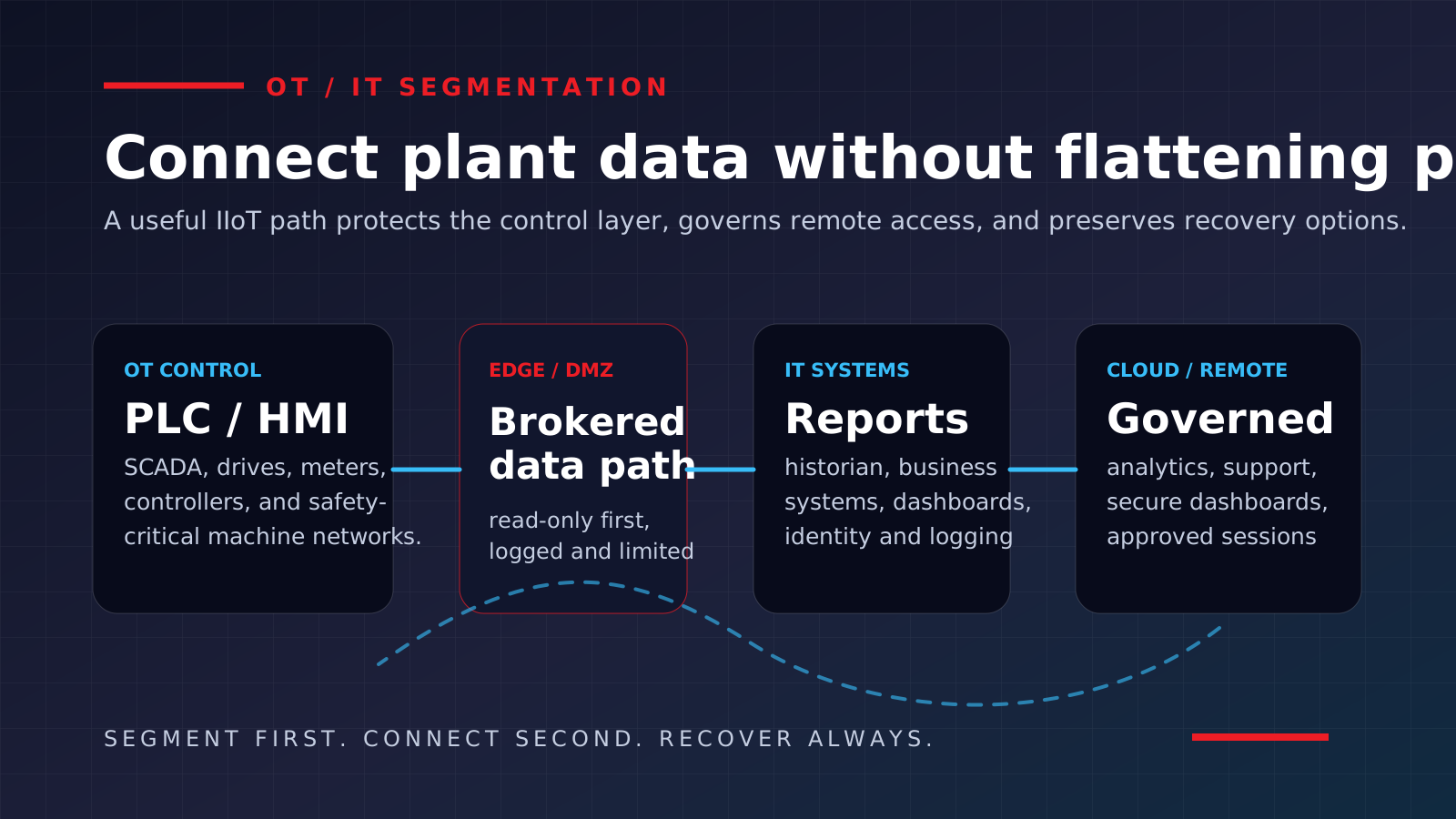
OT and IT network segmentation diagram for connected industrial plants Industrial Cybersecurity

Industrial Cybersecurity For OT And IT Networks: A Practical Guide For Connected Plants

A practical continuity-first guide for securing PLCs, SCADA, IIoT gateways, historians, cloud dashboards, and remote support paths without slowing useful modernization.
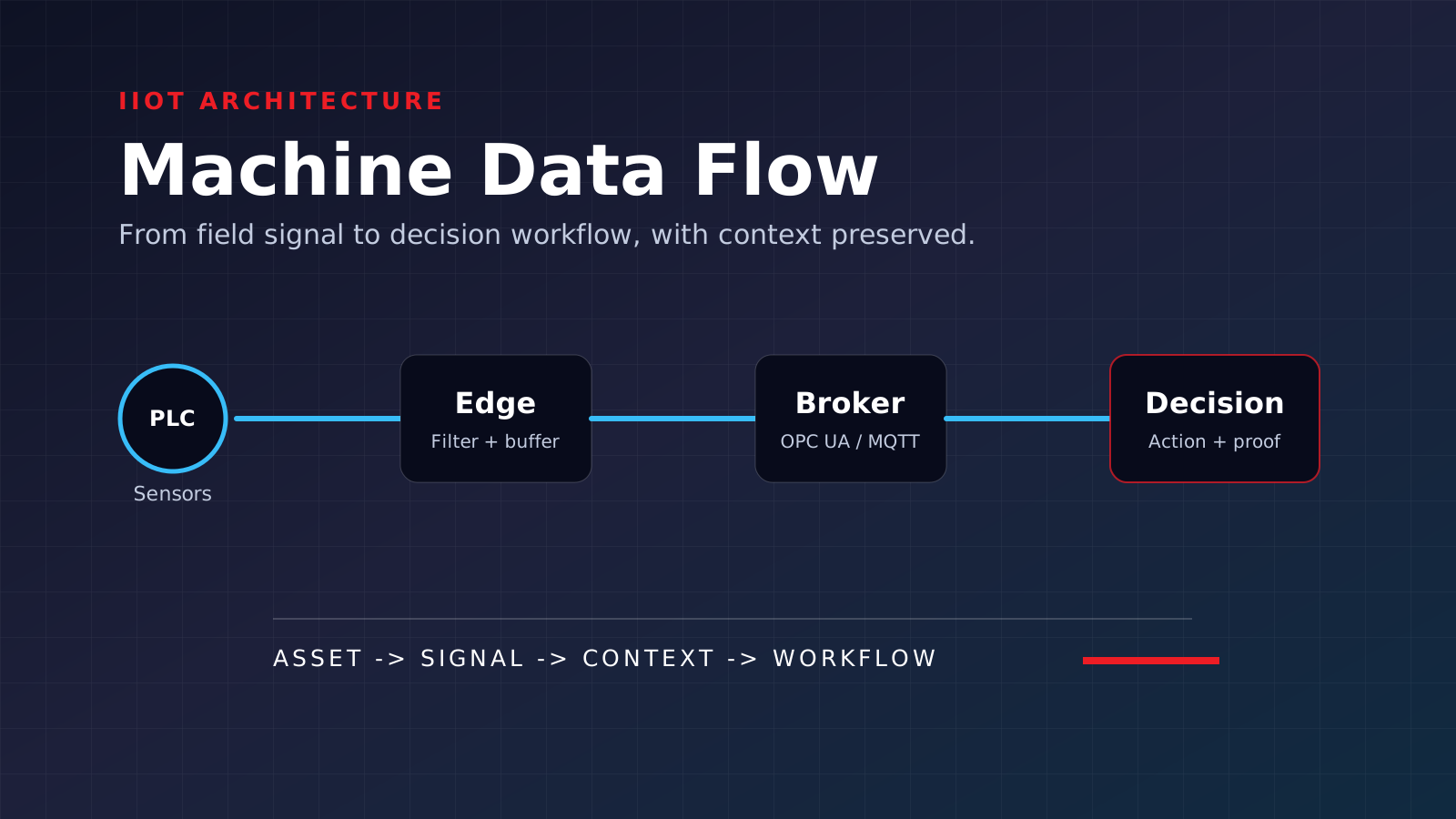
IIoT machine data flow from PLC and sensors through edge, broker, and decision workflow IIoT

IIoT Architecture For Machine Data Flow: Turning Plant Signals Into Strategic Decisions

A refined IIoT architecture guide for turning machine signals, PLC data, and sensor context into decisions that improve uptime, maintenance, energy, and production confidence.
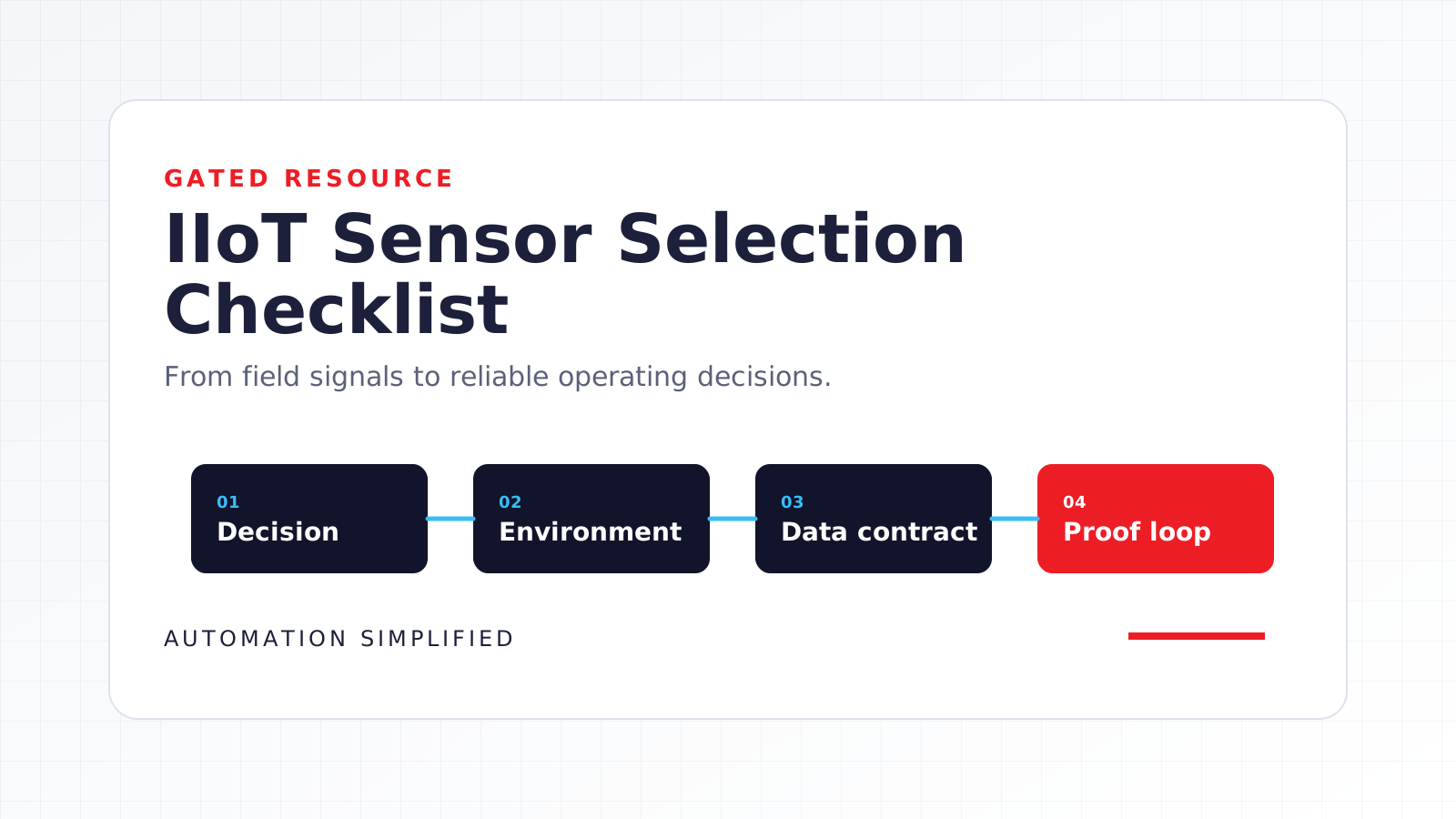
Industrial IoT sensor selection checklist resource cover IIoT

Industrial IoT Sensor Selection Checklist: From Field Signals To Reliable Decisions

A gated resource for selecting IIoT sensors, transducers, and switches that can survive the plant environment and support reliable operating decisions.
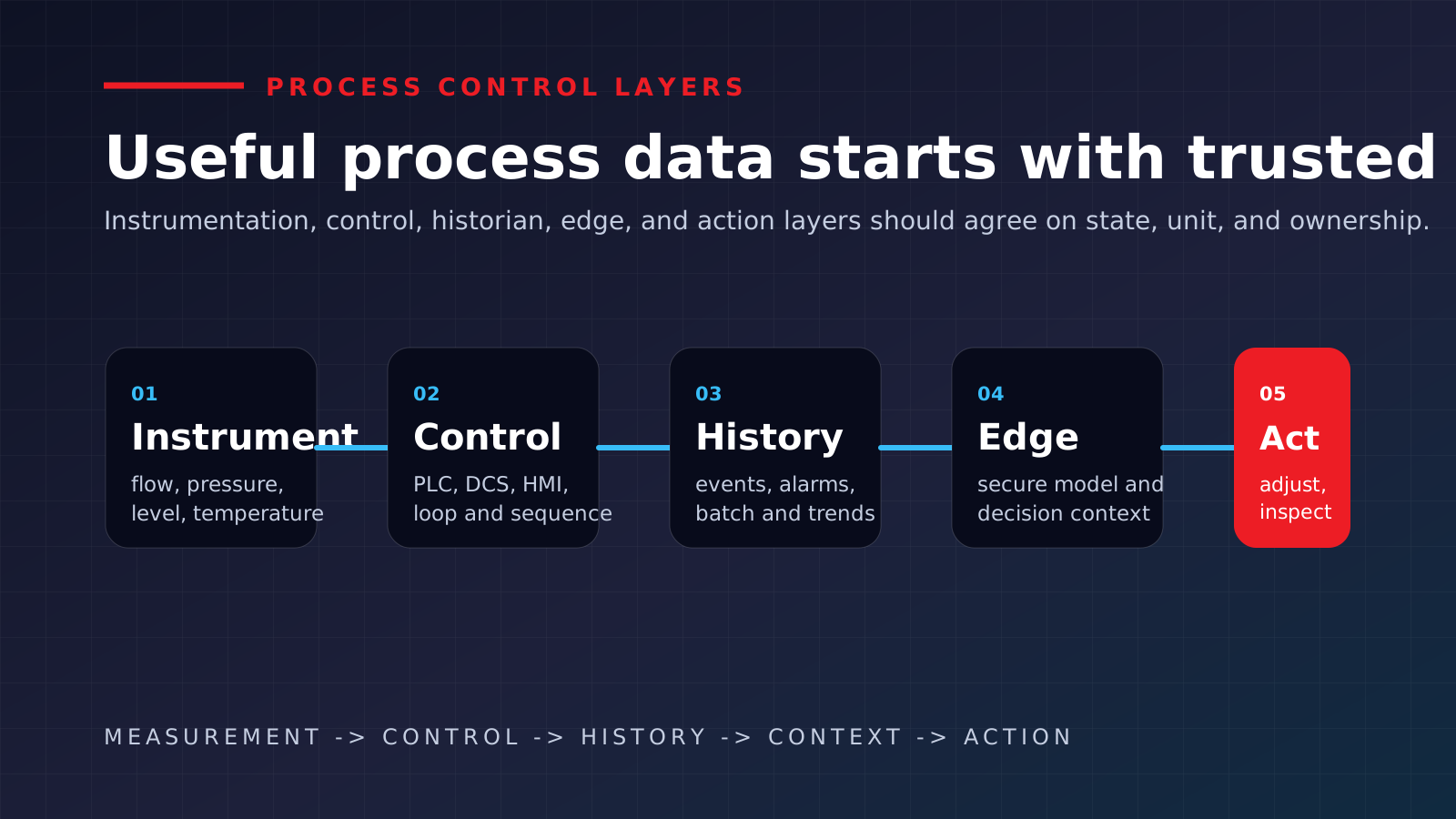
Process automation control layer diagram showing instrumentation, PLC or DCS, historian, edge, and action layers Industrial Automation

Process And Chemical Automation: Control, Visibility, And Safer Decision Workflows

A practical guide to automation and IIoT for process and chemical plants, focused on control reliability, alarms, instrumentation, maintenance, and operational visibility.
Article cover: Manual loops, backups, spare I/O — audits that can expose plant vulnerabilities. Industrial Automation

Manual Loops, Backups, Spare I/O: Audits That Can Expose Plant Vulnerabilities

Loops running in manual, a backup nobody has restored, and the spare channels in one I/O cabinet. Three diagnostics, one afternoon each, all measuring the distance between what your documentation claims and what your plant can prove.

Article cover: Two controllers, one UPS — why redundant hardware isn't a redundant service. Industrial Automation

Two Controllers, One UPS: Why Redundant Hardware Isn't a Redundant Service

Two controllers, two network paths, two I/O drops — and one shared UPS. Why redundant hardware doesn't create a redundant service, what both channels actually share, and the audit that finds it before the outage does.

Article cover: What unreadable PLC code costs you at 2 a.m. Industrial Automation

What Unreadable PLC Code Costs You at 2 A.M.

A contact named M0.0 tells a technician nothing when the line is down. What maintainable PLC code actually means — structure, naming, traceable constants — and a ten-minute drill that measures it better than any audit.

Ladder Logic control foundation showing readable PLC logic as a base for troubleshooting, documentation, and future data quality Industrial Automation

Ladder Logic Foundations: Why PLC Thinking Still Matters In Modern Automation

A practical automation guide for leaders who need PLC logic, machine sequences, safety discipline, and future IIoT data to work as one operating system.

Ready to see what automation could do for your plant?

Discuss Your Project