
Six Predictive Maintenance Field Cards
Six one-page cards for the records a predictive programme keeps skipping: the detection evidence record, the criticality queue, the failure-mode sentence, the measurement contract, the alert anatomy and its ladder, and the pilot registration sheet. Questions and record fields only.

Six one-page cards for the records a predictive programme keeps meaning to write down and never does: the detection evidence record, the criticality queue, the failure-mode sentence, the measurement contract, the alert anatomy and its ladder, and the pilot registration sheet.
Each card carries questions and record fields, and nothing else. No thresholds, no intervals, no scales, no authorisation — because those come from your own plant, and a number borrowed from somewhere else is the fastest way to lose an audit. Every card also carries the one-line boundary the underlying reference states at that point, and the section it came from.
No signup, no email, no form — download what you need.
01 · The detection evidence record
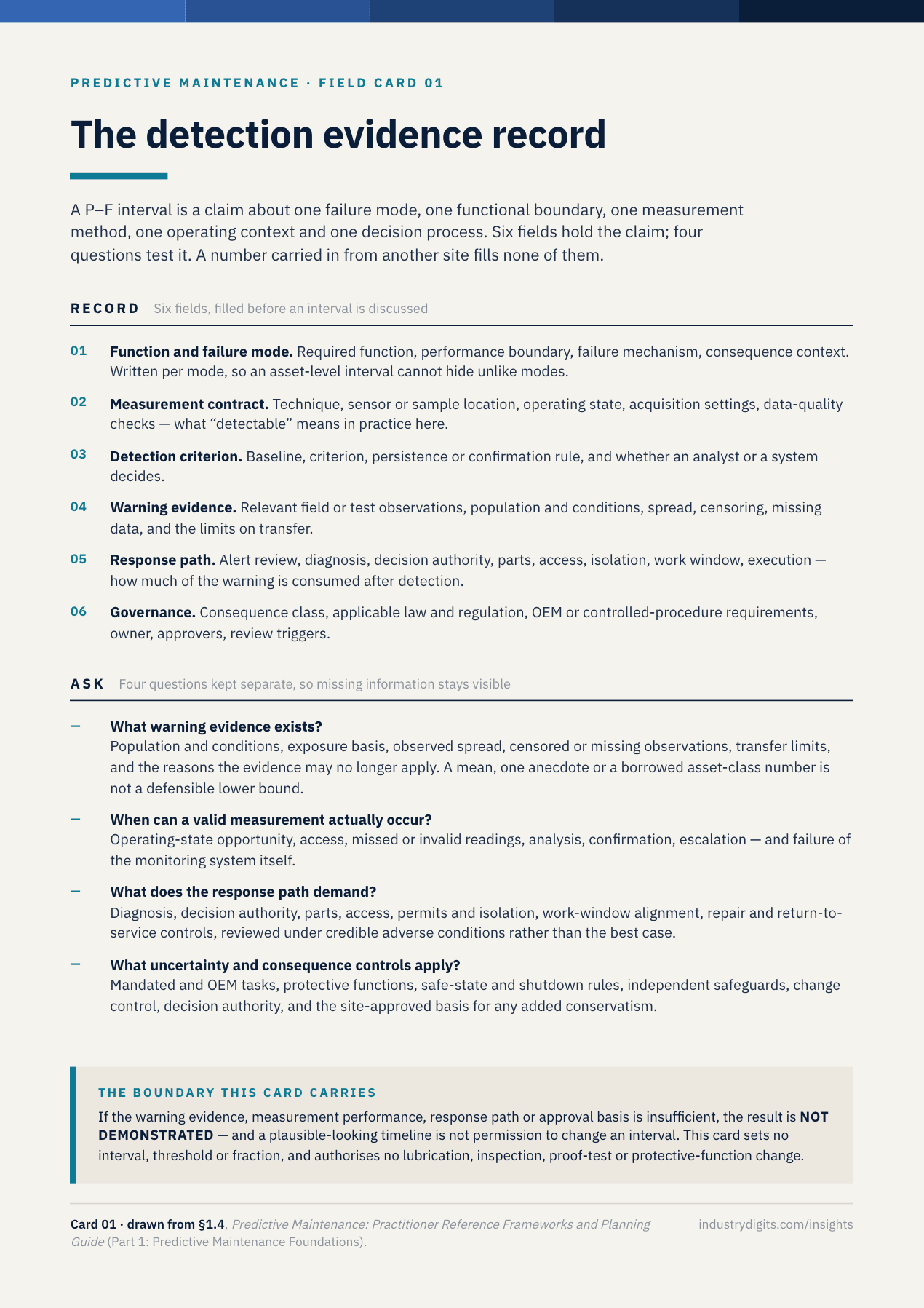
A P–F interval is a claim about one failure mode, one functional boundary, one measurement method, one operating context and one decision process. Six fields hold the claim — function and mode, measurement contract, detection criterion, warning evidence, response path, governance — and four questions test it. A warning window carried in from another site fills none of them.
Download card 01 (PDF) · Pairs with The P–F Interval Is a Measurement Hypothesis
02 · Ordering the queue
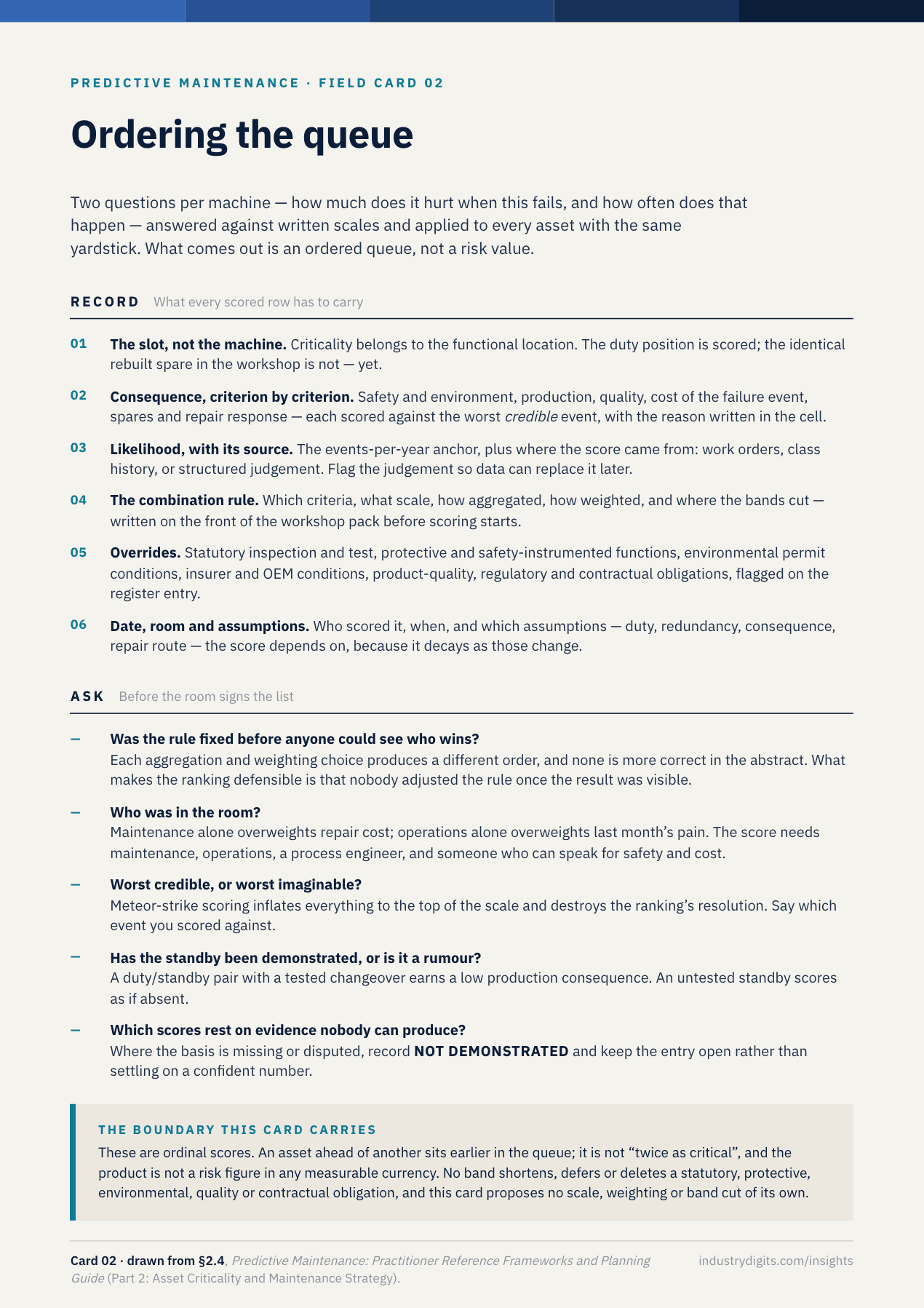
Two questions per machine — how much does it hurt when this fails, and how often does that happen — answered against written scales and applied to every asset with the same yardstick. The card records the slot rather than the machine, the consequence criterion by criterion, the likelihood and its evidence source, the combination rule fixed before scoring starts, the overrides that sit outside the ranking entirely, and the assumptions the score will decay with.
Download card 02 (PDF) · Pairs with From “Everything Is Important” to an Ordered List
03 · Four words, one sentence
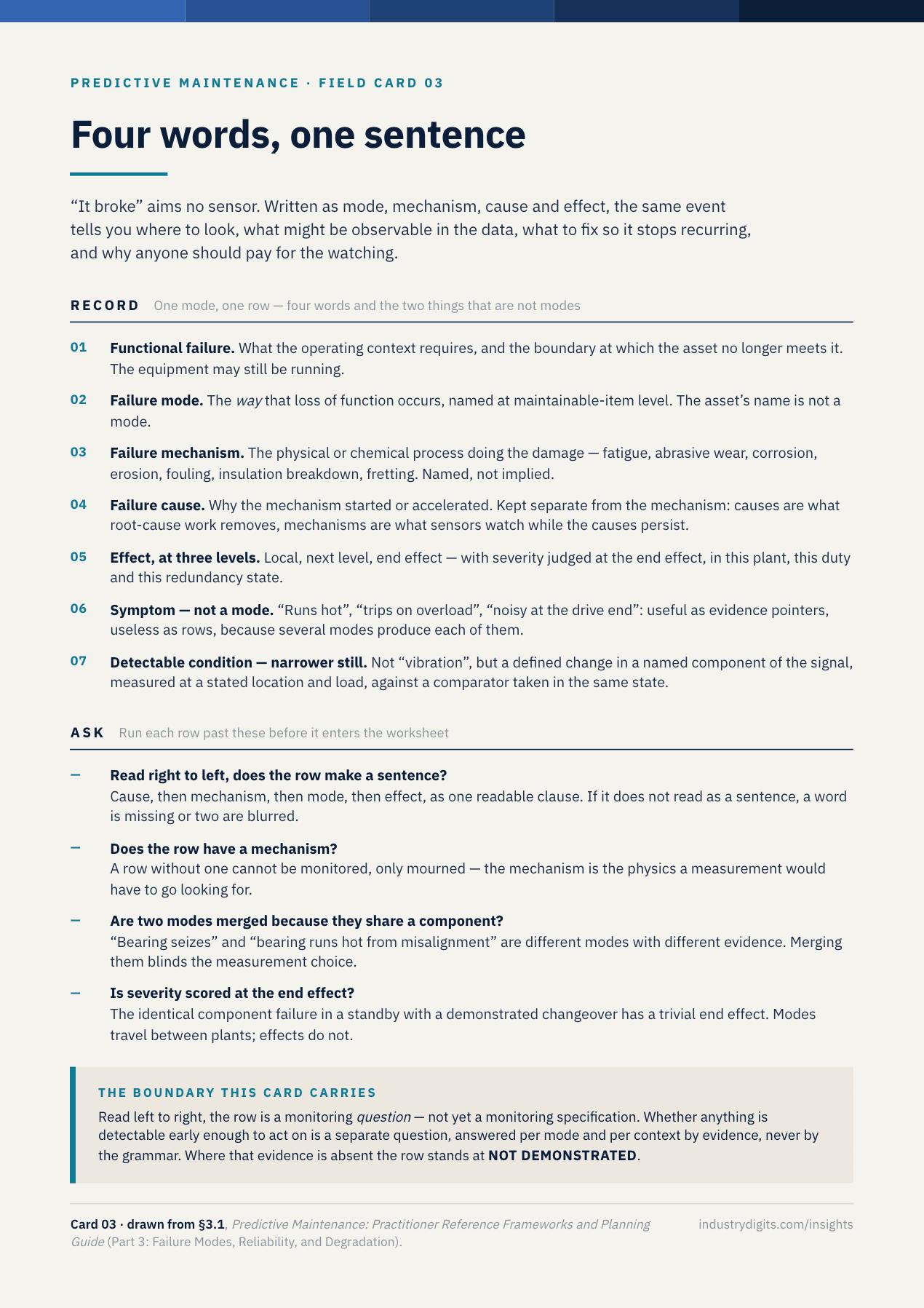
“It broke” aims no sensor. Mode, mechanism, cause and effect — plus the two things that are not modes, symptom and detectable condition — turn the same event into a sentence that tells you where to look, what might be observable in the data, what to fix so it stops recurring, and why anyone should pay for the watching.
Download card 03 (PDF) · Pairs with Bad Actors
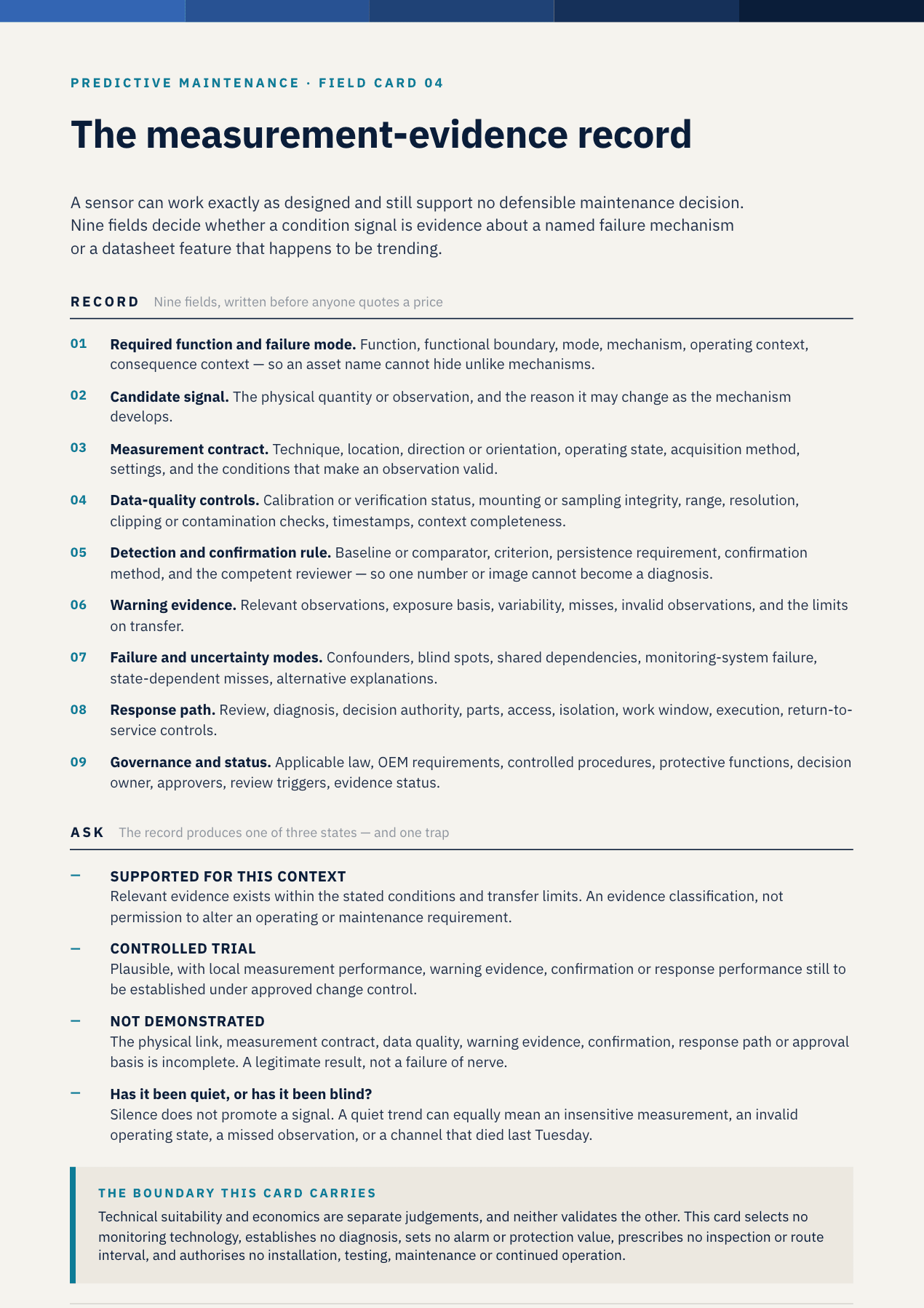
04 · The measurement-evidence record
A sensor can work exactly as designed and still support no defensible maintenance decision. Nine fields decide whether a condition signal is evidence about a named failure mechanism or a datasheet feature that happens to be trending — and the record resolves to one of three states, one of which is not demonstrated. Silence does not promote a signal: a quiet trend can equally be an insensitive measurement, an invalid operating state, a missed observation, or a channel that died last Tuesday.
Download card 04 (PDF) · Pairs with A Data-Quality Problem First
05 · Seven fields, five rungs
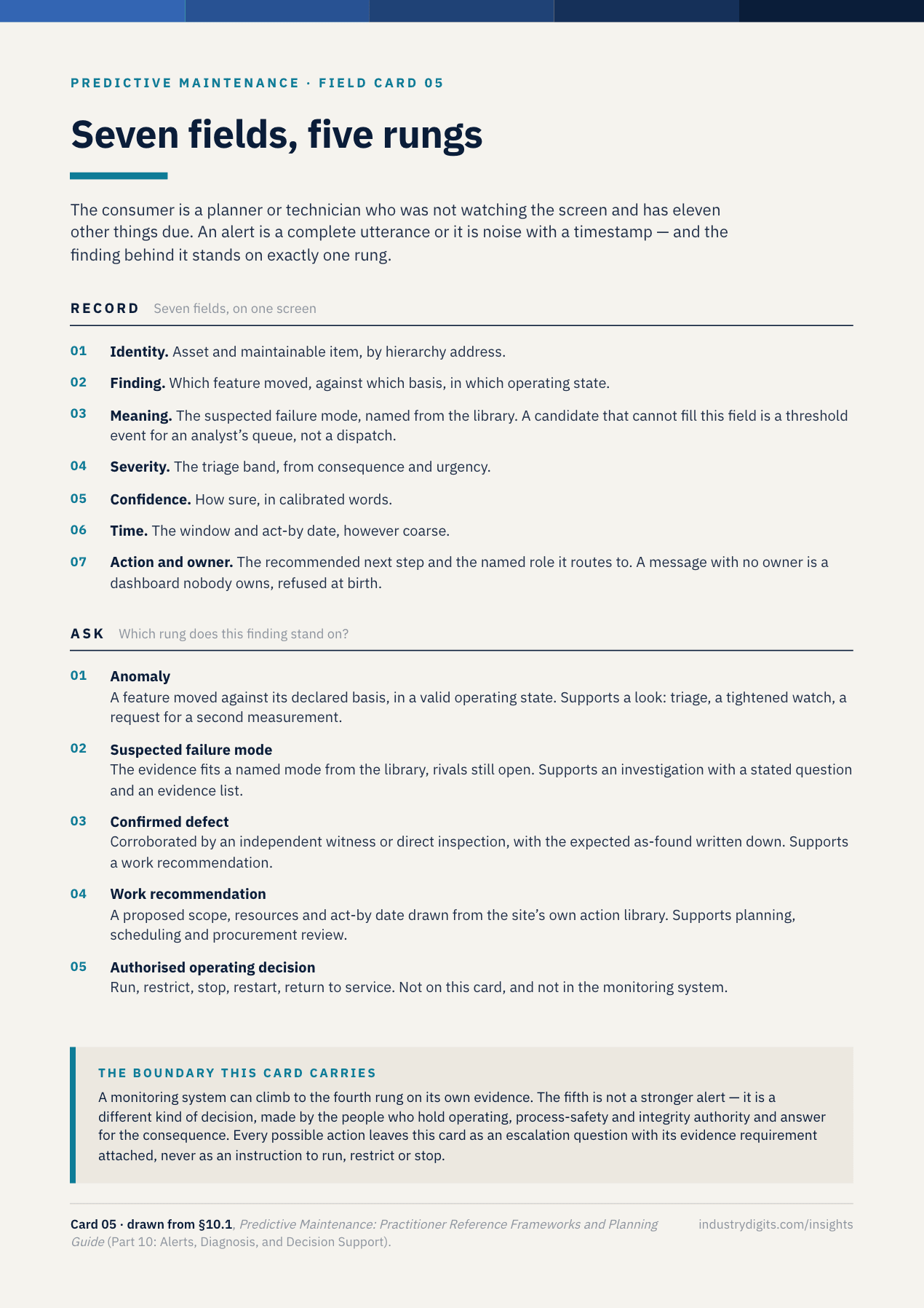
The consumer is a planner or technician who was not watching the screen and has eleven other things due. Seven fields — identity, finding, meaning, severity, confidence, time, action and owner — fit one screen, and a candidate that cannot fill meaning is a threshold event for an analyst’s queue rather than a dispatch. Beneath them, the five-rung ladder that names how far the evidence has actually climbed.
Download card 05 (PDF) · Pairs with The Anatomy of an Alert Worth Acting On
06 · The registration sheet
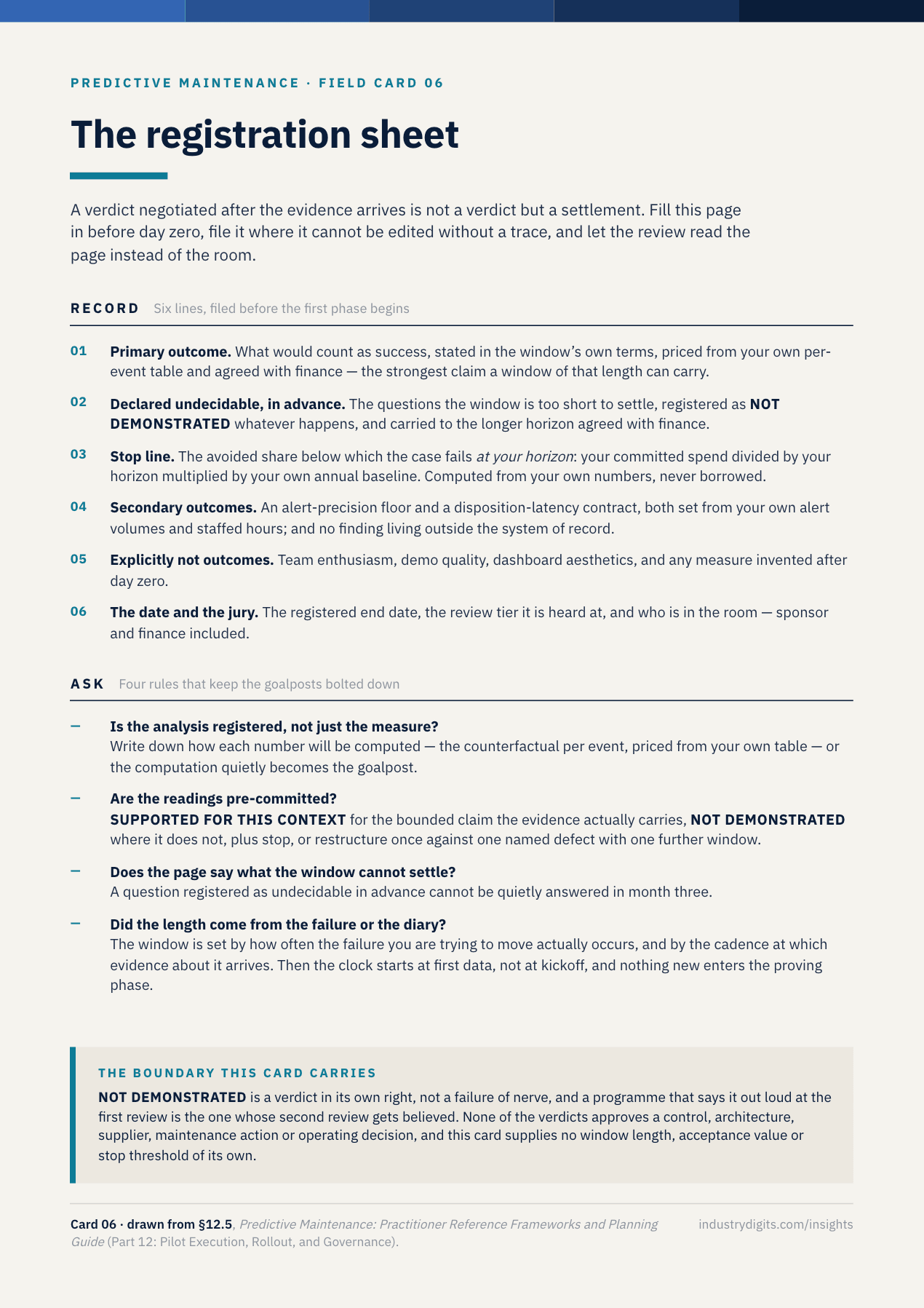
A verdict negotiated after the evidence arrives is not a verdict but a settlement. Six lines, filed before day zero: the primary outcome and how it will be computed, the question the window is too short to settle, the stop line from your own committed spend and your own baseline, the secondaries, what explicitly does not count, and the date with the names of the jury.
Download card 06 (PDF) · Pairs with Pre-Register the Pilot or Don’t Run It
From the course toolkit: two further cards
The Practitioners Academy toolkit for this reference adds two more cards in the same format — same rule, same boundary panels, questions and record fields only.
07 · The data-readiness page
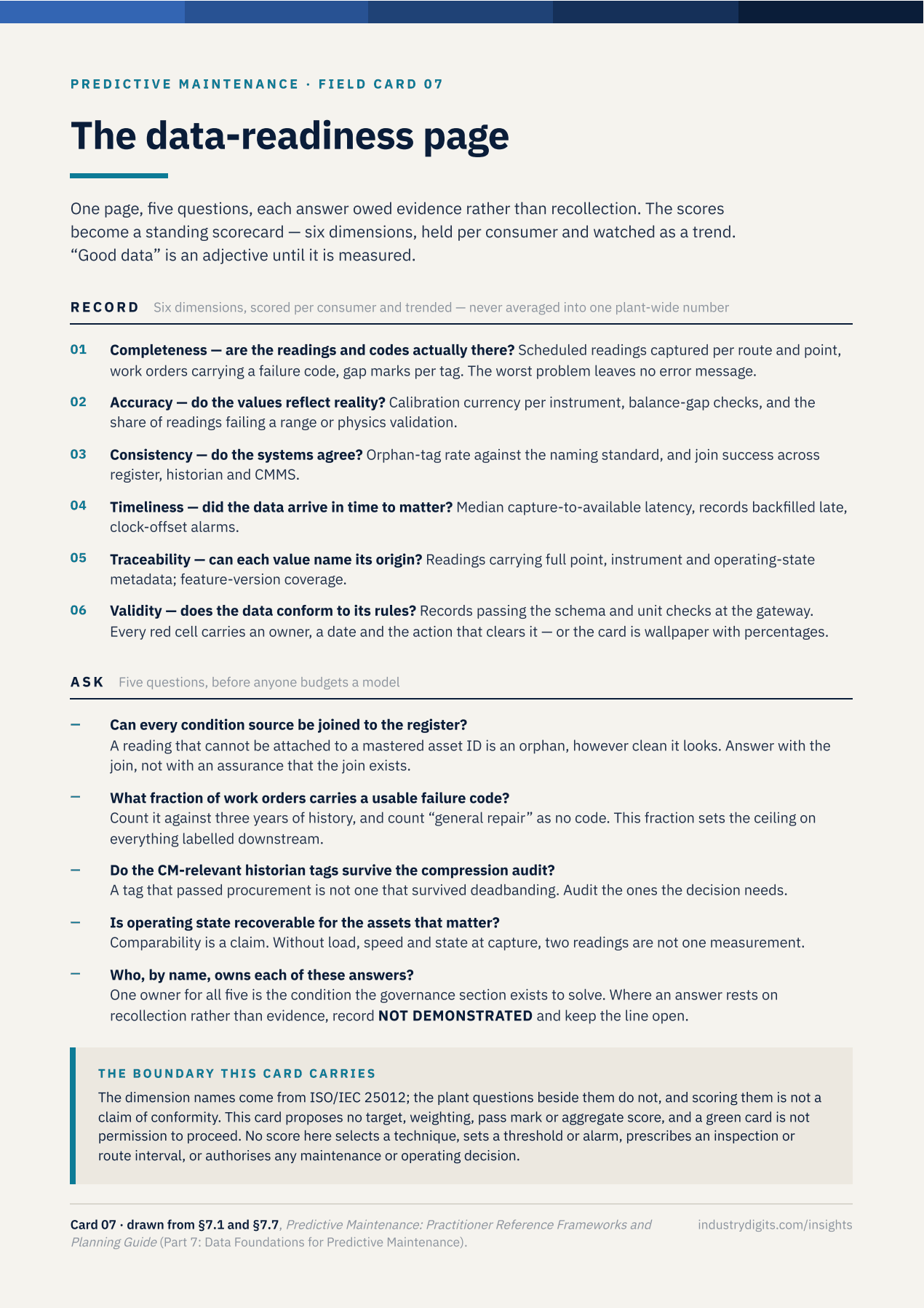
Whether the data can carry the decision is a question you can answer before anyone budgets a model — per consumer of the data, not per warehouse. One page for the six dimensions a readiness claim has to survive, and the record each one leaves behind.
Download card 07 (PDF) · Pairs with Predictive Maintenance Is a Data-Quality Problem First
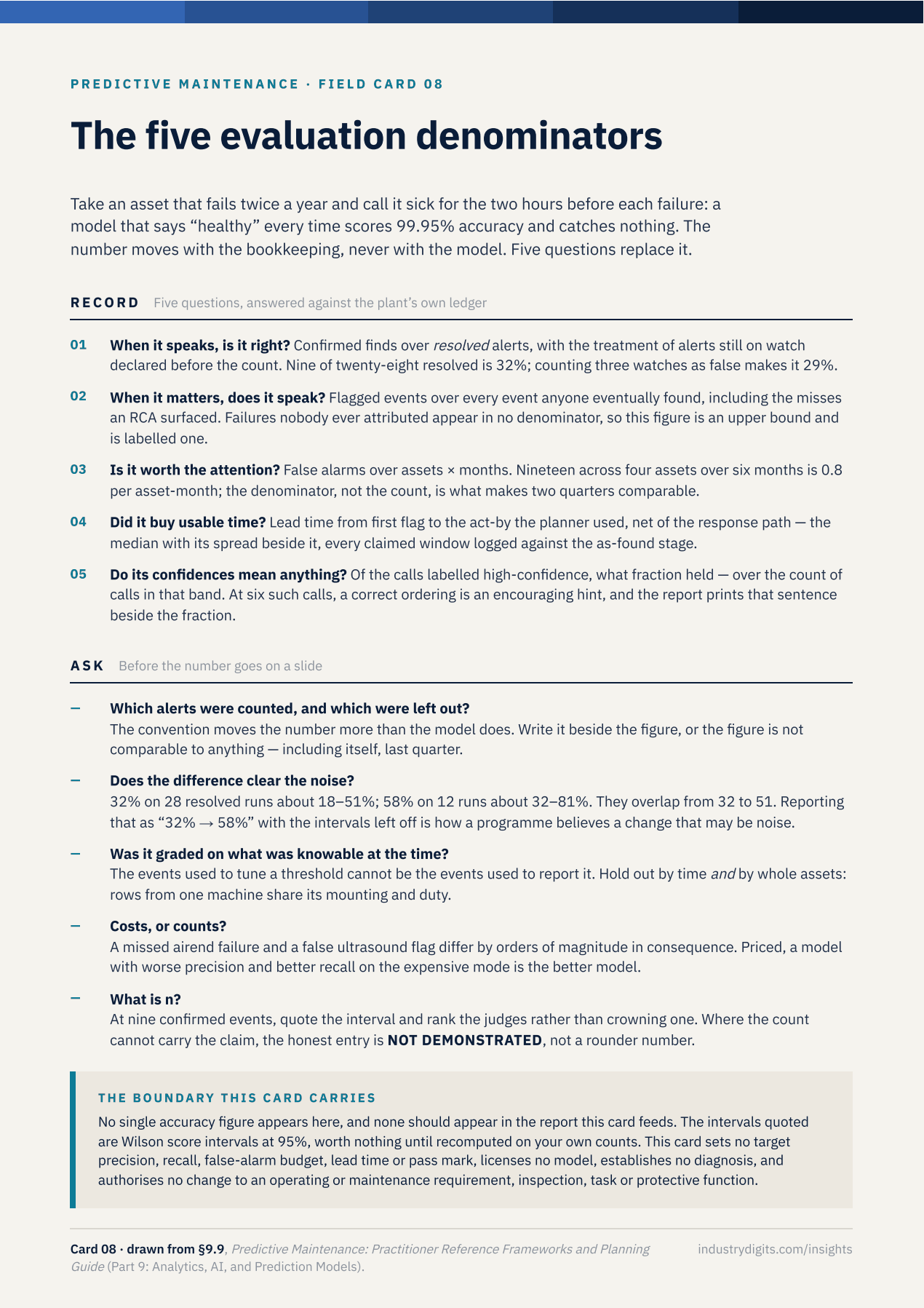
08 · The five denominators
Every evaluation number is a fraction, and the honest part is the denominator. One page for the five denominators an evaluation claim has to declare before precision, recall or a false-alarm rate means anything at all.
Download card 08 (PDF) · Pairs with Remaining Useful Life: A Window, Not a Date
What these cards are, and what they aren’t
They are records: what to write down, what to ask of it, and what the answer cannot establish. They are deliberately not fillable forms, scoring calculators or threshold tables.
Every card stops exactly where your own plant’s numbers begin. Card 02 names the consequence criteria and refuses to supply the scale. Card 06 gives the stop-line arithmetic and refuses to supply the share. Card 01 lists the fields a warning claim has to fill and declines to name an interval. That is not caution for its own sake — a scale, a share or an interval that came from another plant’s cost base, duty and failure history is not evidence about yours, and it is the first thing a reviewer will find.
Each card also carries the boundary its source section states, in one line, at the point where a reader might otherwise act. Where the record cannot be completed, the honest entry on all six is the same: NOT DEMONSTRATED — a verdict in its own right, not a failure of nerve.
Print one. Fill it in by hand against a machine you already argue about. You will know very quickly which of the six your programme is missing.
Which of the six cards describes a record your plant does not currently keep?
The record fields, the evidence questions, and the one-line boundaries printed on each card are drawn from the foundations, criticality, failure-mode, monitoring-technology, alerting and pilot-governance parts of Predictive Maintenance: Practitioner Reference Frameworks and Planning Guide (sections 1.4, 2.4, 3.1, 4.1, 10.1 and 12.5).
Lokesh Chennuru writes Industry Digits field notes for industrial decision makers, focused on automation, IIoT, condition monitoring, predictive maintenance, and industrial AI.
Connect on LinkedInQuestions industrial leaders ask about this
Are the field cards free to download?
Yes. All six cards and the combined six-card PDF download directly, with no signup, no email and no form. They are method references — what to record and what to ask — and they are yours to print, post on a cabinet door or hand to a shift.
What is on each card?
Questions and record fields, and nothing else. Each card carries a RECORD block listing the fields a decision has to fill, an ASK block listing the questions that test them, the one-line boundary the underlying reference states at that point, and the section it was drawn from. There are no thresholds, no intervals, no scales and no authorisation on any of the six.
Why do the cards contain no numbers?
Because a number that came from one plant's cost base, duty and failure history is not evidence about another's. The cards carry the method that produces your numbers — the fields to record, the arithmetic to compute from your own baseline — and deliberately stop where a borrowed threshold would begin.
Which article does each card pair with?
Card 01 pairs with the P–F interval article, card 02 with the criticality article, card 03 with the bad actors article, card 04 with the data-quality article, card 05 with the alert anatomy article, and card 06 with the pilot pre-registration article. Each card also names the section of the underlying reference it was drawn from.
Predictive Maintenance — Practitioner Reference Frameworks and Planning Guide
The twelve-part reference this series draws on: foundations and the value case, asset criticality and strategy, failure modes and degradation, the monitoring technologies, asset-class playbooks, sensors and IIoT architecture, data foundations, signal processing, analytics and prediction models, alerts and diagnosis, work management and CMMS integration, and pilot execution through rollout and governance — 126 sections with 46 technical figures.