
The Unified Namespace Is a Pattern, Not a Product
The hub diagram is genuinely better than the spaghetti it replaces. It is also a diagram — and the distance between the two pictures is not a purchase order but a programme: naming governance, payload discipline, and forty birthplaces connected without forging their birth certificates.

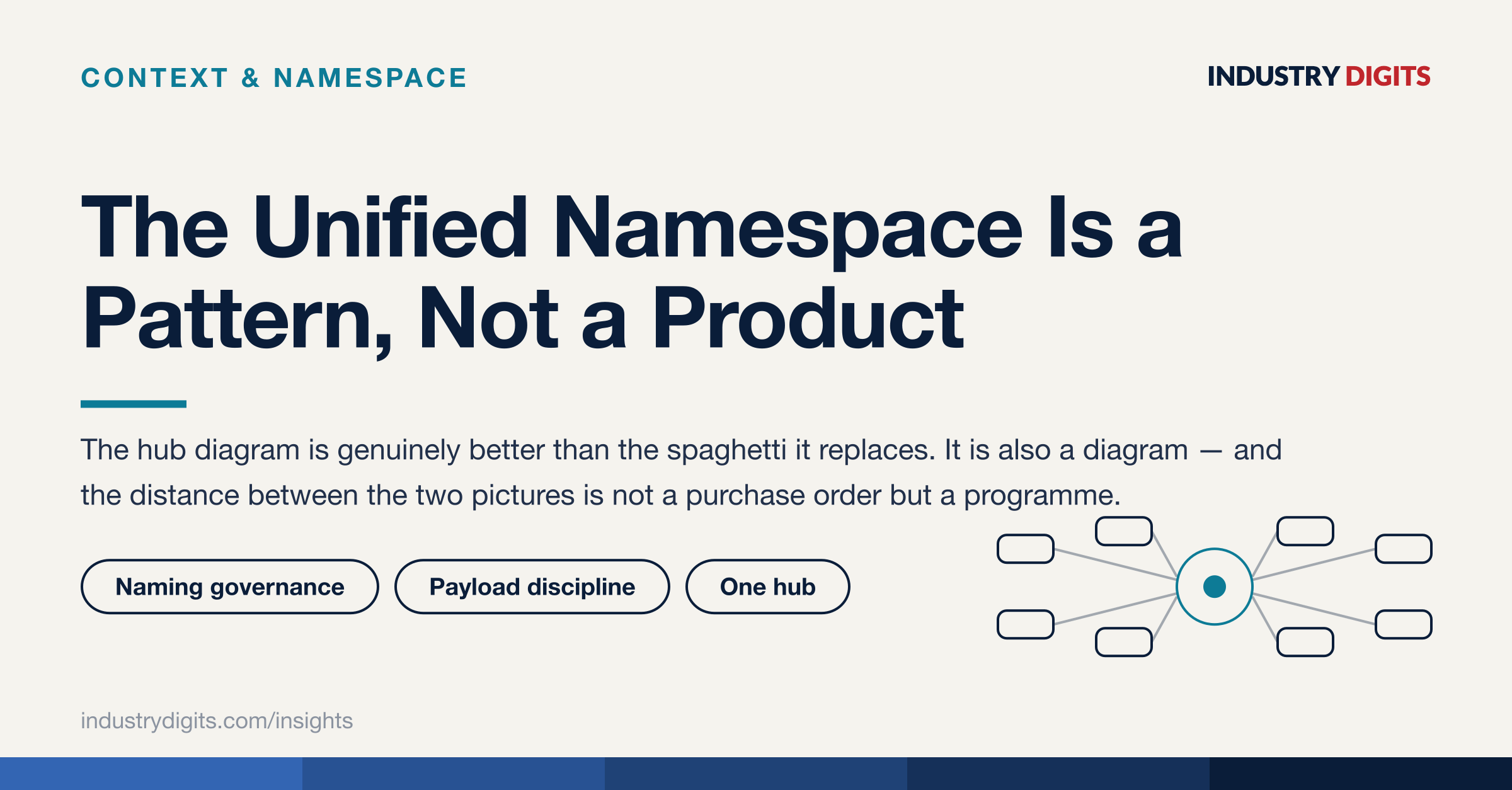
Every integration era has its diagram.
The point-to-point era’s diagram was spaghetti: every system wired to every system it needed, N systems trending toward N-squared interfaces, each one negotiated, documented optimistically, and broken separately.
The unified-namespace era’s diagram is a hub: one broker, one hierarchical namespace covering the enterprise, every producer publishing its state into its place in the hierarchy, every consumer subscribing to what it needs. Integration cost proportional to N. Any new consumer served by a subscription instead of by a project.
The diagram is genuinely better. It is also a diagram — and the distance between the two pictures is not a product purchase but a programme.
The pattern, precisely
A UNS is three commitments, usually though not necessarily implemented on MQTT infrastructure.
One namespace. A single hierarchical naming scheme — commonly organised along ISA-95 lines, enterprise to site to area to line to cell — in which every shared datum has one address.
State, published. Producers publish their current state into the hierarchy as it changes, with report-by-exception and birth-and-death mechanics answering the silence problem. The namespace at any moment is the live model of the operation.
Decoupling. Producers do not know their consumers. Consumers subscribe by address pattern. Adding either is configuration, not a project.
That third commitment is the one that pays, and it pays in a currency most architecture arguments never price: the cost of the next consumer.
What it genuinely solves, and what it deliberately does not
| The UNS actually solves | It deliberately does not |
|---|---|
| N² point-to-point interfaces collapse into N hub connections | history — that is a subscriber's job, with its own retention and retrieval |
| cheap marginal consumers: subscribe, don't project | meaning — naming and payload governance remain exactly as much work |
| one live, browsable state model of the operation | security boundaries — brokers stay zoned and bridged |
| producers decoupled from consumers | operational duty — the broker tier is real infrastructure with real failure modes |
The left column is the honest case for the pattern, and it is a strong one. The interface economics of a brownfield estate are genuinely bad, and they get worse with every project. Collapsing them changes what the site can afford to do next.
The right column is where most disappointment lives.
A UNS is a circulatory system, not a memory. It holds now. History subscribes and stores. Conflating the two produces a broker sized for an archive and an archive with a broker’s retention.
A UNS does not create meaning. The hierarchy’s names, units and payload schemas are governance work that exists whether or not a hub does. What the namespace changes is that the work now has one very public place to live, which makes its absence visible rather than distributed. A UNS built without that governance republishes the estate’s existing confusion at higher speed and with better uptime.
A UNS does not abolish security boundaries. Brokers deploy per zone with governed bridges between them, not as one flat bus laid across the security architecture.
A UNS adds a dependency. The broker tier is now infrastructure with capacity arithmetic to do, fleet duties to discharge and hardening to apply — because a hub is also a single place to fail, and a single place to amplify a flood.
Adopting it without the kool-aid
The honest adoption path is incremental, and it starts with governance rather than with a purchase order.
- 01 Govern the namespace first
The hierarchy and the payload discipline are the actual asset; the broker is a commodity. A namespace designed after the broker is installed will be designed around whatever the first two publishers happened to do.
- 02 Connect birthplaces through governed conversions
Few hops, close to the source, no re-stamping. Every connection into the hub either carries a value's original names, units, timestamps and quality forward or forges new ones — and a hub full of forged birth certificates is a faster way to be wrong.
- 03 Zone the brokers to match the security architecture
Per-zone brokers with governed bridges, not one flat bus. The convenience of a single address space is not a reason to dissolve a boundary that exists for consequence reasons.
- 04 Let each new consumer prove the economics by being cheap
The pattern's claim is that the marginal consumer costs a subscription rather than a project. Test the claim consumer by consumer, and retire legacy point-to-point links one at a time as their consumers migrate.
At Meridian, the invented plant the underlying reference runs on, the illustrative sequence goes: the utilities flow publishes into a site namespace first; the historian subscribes; two dashboards and the energy report follow by subscription, roughly a week each; and the legacy point-to-point links are retired one at a time as their consumers move across.
The diagram converges on the hub over eighteen months, project by project, without a single big-bang cutover.
That is what pattern-not-product means in practice. The UNS is the shape the estate grows into, under governance, because each increment paid for itself.
An exercise that costs an afternoon
You do not need a broker to test whether a UNS would help you, and you should not buy one to find out.
Count your interfaces instead.
Take the systems that exchange plant data at your site — SCADA, historian, MES, ERP, the dashboards, the reporting tools, whatever the analytics people built. Draw a line for every point-to-point link that actually exists, not every one the architecture diagram claims.
Then answer four questions about the picture.
- How many links are there, and how many people know all of them exist? The gap between those two numbers is the maintenance risk you are currently carrying.
- What did the last new consumer cost? Not the licence — the integration effort, the meetings, the mapping, the testing. That figure is the one a hub is supposed to reduce, and if it is already small, the pattern has less to offer you than the diagram suggests.
- For any two systems that both report the same quantity, can you name which is authoritative? If not, the problem is naming governance, and a hub will not fix it — it will only centralise it.
- If one link stopped, how would you find out? A link nobody monitors is a link that has already failed silently at least once.
The result that most often surprises people is question two. Plants that assume they need a namespace sometimes discover their integration cost is dominated by naming and unit disputes rather than by interface count — which means the governance work pays first, and the broker can wait until there is something worth publishing.
That sequencing is the entire practical argument. Namespace first, governance always, brokers zoned, history subscribed, and every increment paying its own way.
How many interfaces would break if you renamed one asset tomorrow?
The three commitments, the solves-and-does-not table, and the namespace-first adoption sequence are from Industrial IoT and Data Architecture: From Sensor to Historian to Dashboard (Part 4: Historians and Time-Series Storage, section 4.5).
Lokesh Chennuru writes Industry Digits field notes for industrial decision makers, focused on automation, IIoT, condition monitoring, predictive maintenance, and industrial AI.
Connect on LinkedInQuestions industrial leaders ask about this
What is a unified namespace?
Three commitments, usually but not necessarily implemented on MQTT infrastructure. One namespace: a single hierarchical naming scheme, commonly organised along ISA-95 lines, in which every shared datum has one address. State published: producers publish their current state into the hierarchy as it changes, so the namespace at any moment is the live model of the operation. Decoupling: producers do not know their consumers, consumers subscribe by address pattern, and adding either is configuration rather than a project.
What does a UNS actually solve?
The interface economics of the estate. Point-to-point integration trends toward N-squared negotiated interfaces, each documented optimistically and broken separately. A hub collapses that into N connections, and the marginal consumer — a new dashboard, a new model, a corporate rollup — becomes cheap enough to add by subscription instead of by project. That property is what makes later scaling waves affordable.
Does a unified namespace store history?
No. A UNS is a live circulatory system, not a memory: it holds now. History is a subscriber — the record subscribes to the namespace and stores what it needs. Treating the hub as an archive confuses two different jobs with different retention, retrieval and capacity characteristics.
Does adopting a UNS create meaning?
No, and this is the most common disappointment. The hierarchy's names, units and payload schemas are governance work that has to be done regardless; the namespace merely gives that work one very public place to live. A UNS built without naming governance and payload discipline republishes the estate's existing confusion at higher speed and with better uptime.
Does a UNS replace network security zoning?
No. Brokers deploy per zone with governed bridges between them, not as one flat bus across the security architecture. The broker tier also becomes real infrastructure with capacity arithmetic, fleet management duties and hardening requirements of its own — because a hub is also a single place to fail, and a single place to amplify a flood.
Industrial IoT and Data Architecture — From Sensor to Historian to Dashboard
The nine-part reference this series draws on: the data value chain, the sensing layer, edge and acquisition, plant networks, historians and time-series storage, context and asset models, dashboards and analytics, security and chain reliability, and the implementation playbook — 40 sections covering signal families, protocol theories, timestamp discipline, compression and retrieval, tag naming, asset models, data contracts, notification engineering, threat modelling, and the pilot-to-wave economics a finance function can audit.