
5 Bearing Failure Signals: How To Catch Critical Asset Risk Before The Line Stops
A practical field guide for using vibration, temperature, current, lubrication evidence, and operator observations to turn bearing risk into planned maintenance action.

An unplanned bearing failure is rarely just a bearing problem. It becomes lost throughput, emergency maintenance, delayed dispatch, secondary damage, urgent spares, and a maintenance team forced into firefighting.
For industrial leaders, the real question is not whether a dashboard can show vibration. The question is whether the plant can see a credible change early enough to inspect, plan, slow down, lubricate, align, or replace before the asset controls the schedule.
Bearing condition monitoring should create a decision window. Standards such as ISO 17359 for condition monitoring setup, ISO 20816-3 for machine vibration evaluation, and ISO 15243 for bearing damage classification are useful anchors. The article below translates that discipline into practical plant language.
Case context: when a bearing warning arrives too late
The most useful way to read bearing signals is through consequence. In the East Palestine derailment investigation, the NTSB said a defective wheel bearing overheated and failed before the train derailed on February 3, 2023. The crew did not receive a hot-bearing warning until the train passed a detector in East Palestine, when the bearing was already close to axle failure. The lesson is not that temperature evidence is worthless. The lesson is that a late warning can still be technically correct and operationally insufficient.
A more productive industrial pattern appears in International Cement Review’s roller-press bearing case. Seven months after an online monitoring system was commissioned, the system detected a deviation in bearing vibration patterns. Specialists analysed the case within 24 hours, the plant ordered spares, and the damaged bearing was changed during a planned stoppage. The value came from converting early evidence into a scheduled maintenance decision.
The five bearing failure signals
The five signals in this article are not five disconnected alarms. They are five forms of evidence that should be interpreted against machine state, load, speed, measurement point, and maintenance history.
- Vibration or shaft motion. A change in baseline vibration, defect-frequency content, looseness, imbalance, or misalignment can indicate that the mechanical condition has changed. ISO 13373-1 anchors vibration condition-monitoring procedures, while ISO 20816-3 provides in-situ vibration evaluation context for many coupled industrial machines.
- Temperature drift. Bearing temperature becomes meaningful when it is compared with load, speed, ambient condition, lubrication state, and recent maintenance. Machinery Lubrication’s review on detecting premature bearing failure explains why thermal evidence is useful, but often later than vibration or oil analysis for many bearing-failure paths.
- Motor current or electrical signature. Current can expose abnormal load, restriction, jamming, eccentricity, or electrical-machine behaviour that changes the duty imposed on a bearing. ISO 20958 sets out online electrical-signature-analysis guidance for three-phase induction motors.
- Lubricant and particle evidence. Oil or grease condition can reveal contamination, viscosity change, additive depletion, wear debris, or lubrication-starvation risk before the bearing is dismantled. ISO 4406 gives the solid-particle cleanliness code, ISO 14830-1 frames tribology-based monitoring, and lubrication-failure mechanisms are summarized in Machinery Lubrication’s rolling-element bearing review.
- Field inspection and operator observations. Sound, smell, heat, leakage, looseness, unusual movement, recent work, and process changes make sensor evidence more actionable. ISO 17359 is the broader programme anchor: it pushes condition monitoring toward failure mode, measurement method, diagnosis, prognosis, and decision response rather than isolated readings.
ISO 15243 is the damage-classification reference that connects these signals back to visible rolling-bearing damage modes after inspection. It should be used as a failure-analysis anchor, not as a substitute for live monitoring.
What the decision maker should care about
| Operating exposure | Useful evidence | Maintenance response |
|---|---|---|
| Critical rotating asset stops without warning | Rising vibration under comparable operating state | Prioritize inspection before the next production window closes |
| Bearing heat rises after lubrication or alignment issue | Temperature drift confirmed against load and speed | Inspect lubrication, cooling, mounting, and operating condition |
| Asset looks normal but current changes | Motor current signature and load trend | Check restriction, overload, misalignment, or process change |
| Lubrication or contamination risk exists | Oil or grease condition evidence | Plan sampling, sealing, lubricant review, or cleaning action |
| Operators hear or feel a change | Field observation linked with trend history | Use human evidence as context, not as the only trigger |
The value is control. A good monitoring pattern gives the team more time, fewer surprises, and a clearer reason to act.
Service on evidence, not on the calendar. The asset will usually tell you when something has changed — you just have to be listening.
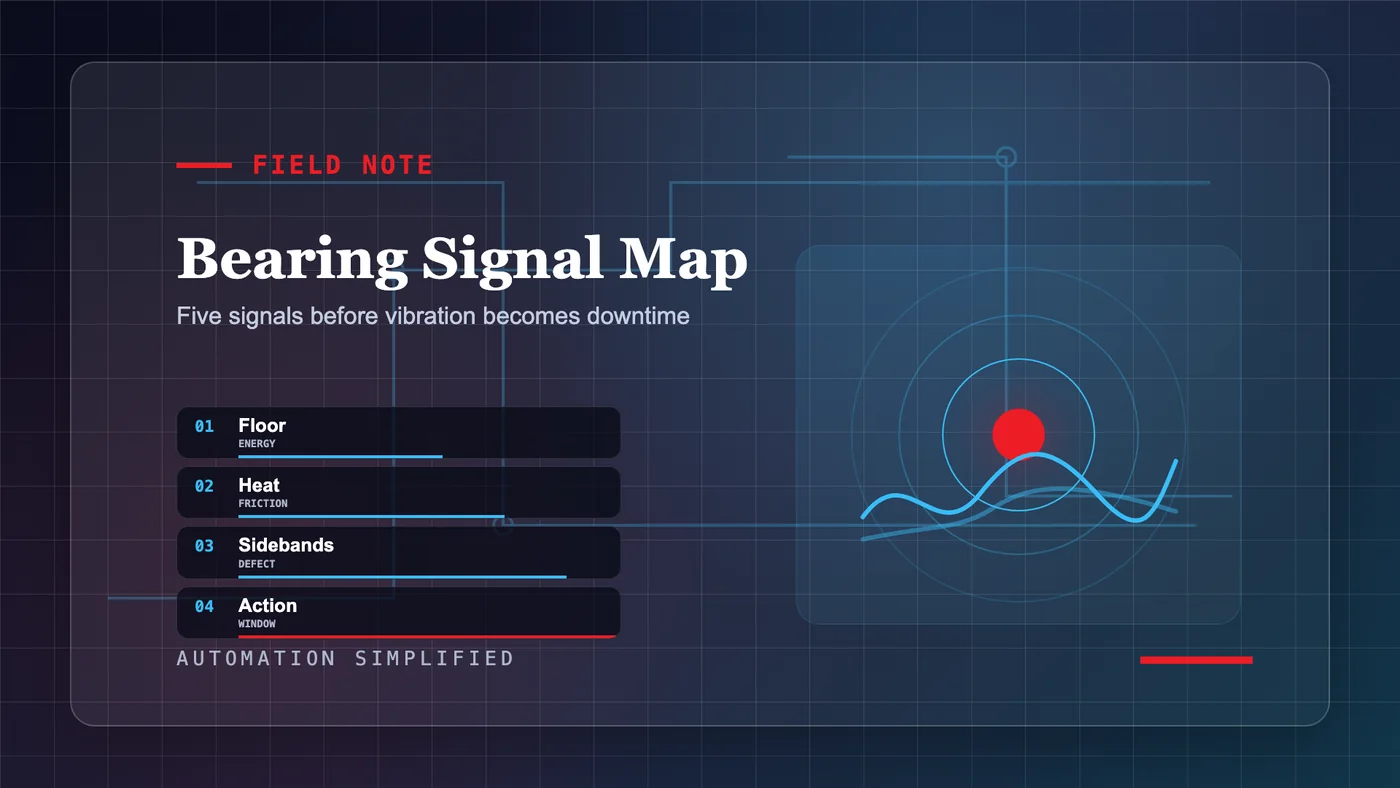
A rising vibration floor
The earliest useful signal is often a change in baseline vibration. As clearance, lubrication, mounting condition, imbalance, looseness, or alignment changes, vibration energy can rise before the asset stops.
The important word is baseline. A single vibration value is weak without operating state. The same value can mean different things during startup, steady production, washdown, low load, high load, or after a product change.
Useful vibration monitoring should record:
- Measurement point and mounting condition.
- Speed and load state.
- Baseline trend under comparable conditions.
- Threshold logic and alarm persistence.
- The person who owns the inspection response.
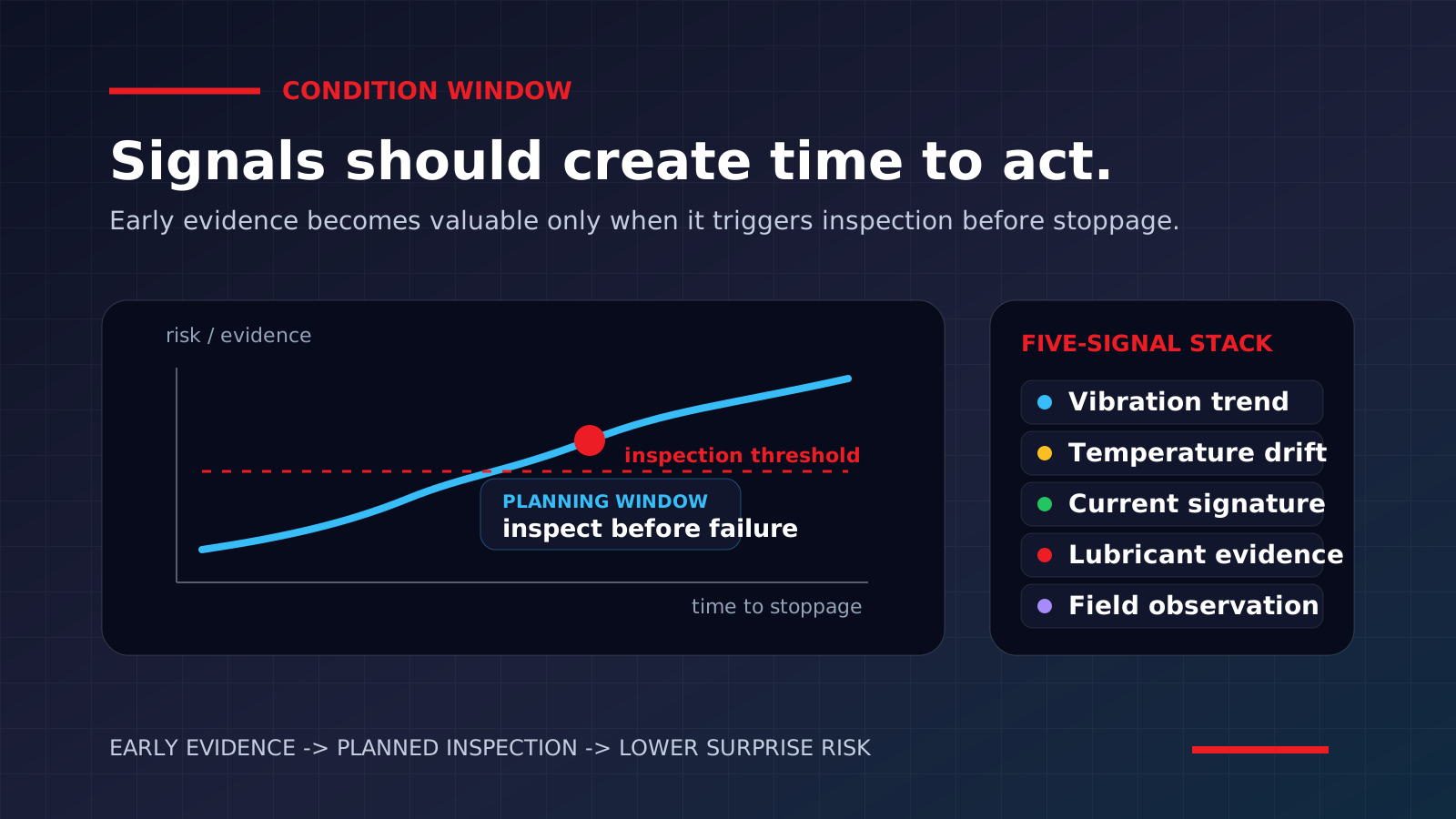
Why sampling interval matters
The difference between periodic and continuous monitoring is not that one method is serious and the other is weak. Periodic routes can be disciplined, and they remain appropriate for many assets. The limitation is temporal coverage: a short vibration event can appear, cross a defined action band, and return toward baseline between two inspection rounds.
ISO 13373-1 explicitly treats both continuous and non-continuous vibration monitoring as valid modes, but it also anchors the work in measurement method, transducer location, attachment, operating condition, and data collection discipline. ISO 20816-3 adds the broader in-situ vibration evaluation context for many coupled industrial machines above 15 kW and between 120 r/min and 30,000 r/min. It is useful for evaluating machine vibration severity, but it is not a complete bearing-fault diagnostic method by itself.
The practical point is this: an alarm limit without sampling strategy is incomplete. A weekly route, a daily handheld reading, a 30-second wireless trend, and a high-frequency diagnostic capture do not see the same machine history.
| Monitoring mode | What it sees well | What it can miss | Best use |
|---|---|---|---|
| Periodic route | Stable condition drift, repeatable baseline checks, route discipline | Short excursions between rounds | Lower-criticality assets or mature baselines |
| Continuous trend | Load-linked excursions, recurring short events, alarm persistence | Detailed bearing defect classification if sampling is too sparse | Critical assets where the decision window is short |
| Diagnostic vibration capture | Frequency-domain evidence, bearing characteristic patterns, root-cause investigation | Broad rollout economics if every asset is over-instrumented | Assets already in watch or investigation state |
Public failure investigations show why this timing question deserves respect. The NTSB concluded that the February 3, 2023 East Palestine derailment was caused by a defective wheel bearing that failed and overheated; the crew did not receive a hot-bearing warning until the train passed the detector in East Palestine, when the bearing was already close to axle failure. This is a rail example, not a factory bearing case, but it illustrates a general condition-monitoring lesson: a late thermal warning can be real and still arrive too late for comfortable intervention.
Industry case material points in the other direction. In a cement roller-press case reported in International Cement Review, an online condition monitoring system detected a deviation in bearing vibration patterns seven months after commissioning; the plant ordered spares and changed the bearing during a planned stoppage, avoiding secondary damage. The value was not a magical prediction. It was earlier evidence, interpreted by specialists, converted into a planned maintenance action.
From the field signal to the maintenance decision
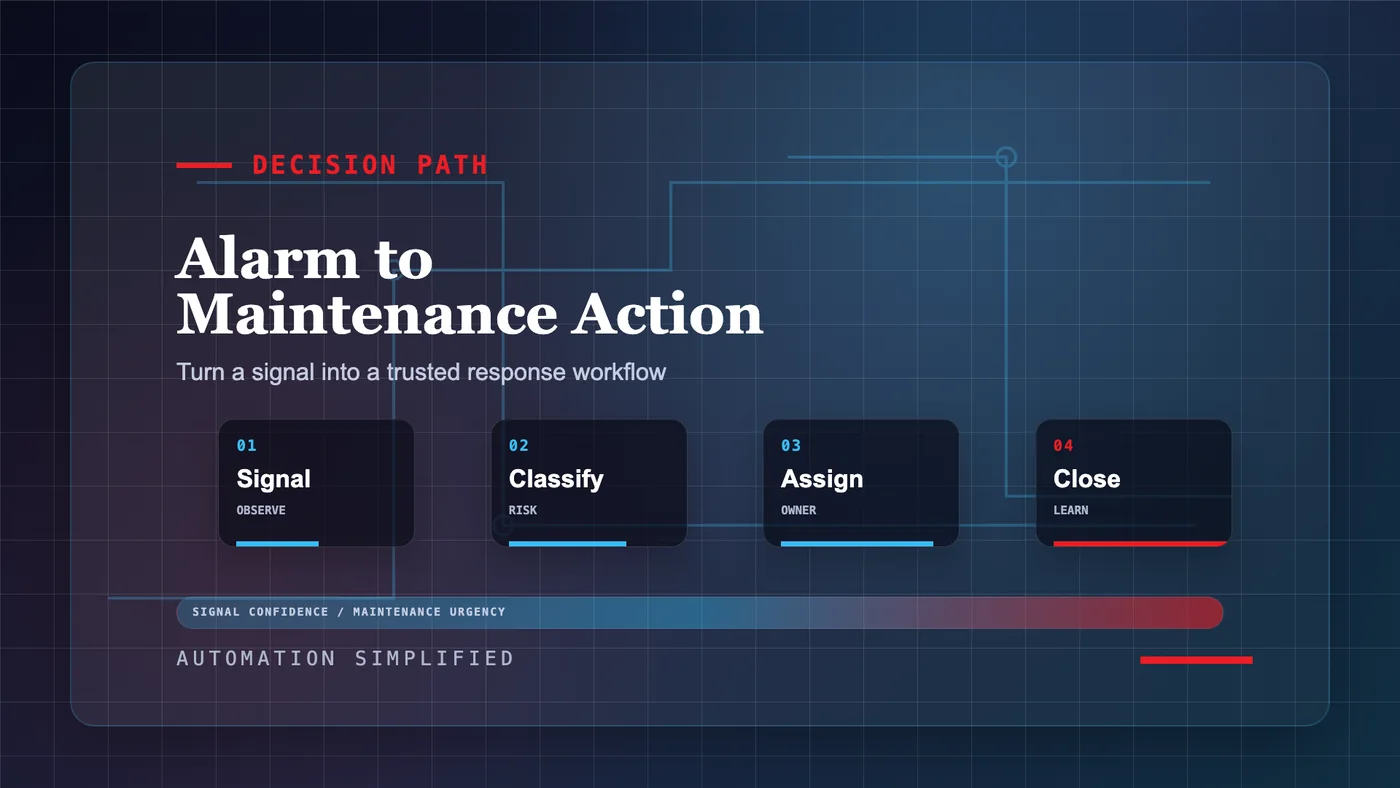
Field data gets more useful when it is tied to the operating state of the asset. A stable trend during normal load means something different from the same trend during start-up, washdown, or a recipe change.
Temperature that drifts
A failing bearing rarely jumps in temperature immediately. It drifts. A steady rise over several runs, especially when load is stable, is worth investigating even when the asset still sounds normal.
Temperature is not always the earliest signal, but it is often trusted by maintenance teams because it is intuitive. It is strongest when used with vibration, current, operating state, and inspection notes.
Use temperature as a decision signal when it can answer a practical question:
- Is friction rising after lubrication?
- Is the casing temperature changing under similar load?
- Is heat increasing after alignment or mounting work?
- Is the temperature pattern local to one bearing or common across the machine?
Current, lubricant, and field evidence
- Characteristic vibration patterns that suggest raceway, rolling element, cage, looseness, imbalance, or alignment issues.
- Motor current signature changes under comparable load, especially where restriction, jamming, overload, or misalignment may be involved.
- Lubricant or particle evidence that supports investigation of contamination, wear, lubrication starvation, or sealing issues.
- Operator observations that confirm a change in sound, heat, smell, movement, vibration, or product behavior.
These signals should not compete with each other. They should strengthen the same maintenance response. For example, a rising vibration trend is more credible when temperature, current, lubrication condition, and operator notes point in the same direction.
Response protocol before the alarm becomes noise
Use a response protocol before rolling the pattern across more assets:
| Monitoring decision | Disciplined response |
|---|---|
| What changed? | Trend, threshold, rate of change, or operating-state comparison |
| Where did it change? | Asset, bearing location, side, drive end or non-drive end, and measurement point |
| When did it change? | Load, speed, shift, batch, production state, maintenance event, or environmental condition |
| Who acts? | Named maintenance, reliability, or production owner |
| How is value verified? | Reduced diagnosis time, planned inspection, avoided secondary damage, or better shutdown planning |
This protocol prevents the common failure mode: technology is installed, alerts appear, and no one is accountable for the next action.
The Industry Digits view
For small and mid-sized industrial companies, bearing monitoring should not begin with the most advanced analytics model. It should begin with criticality, signal trust, and a response workflow.
Start with a small number of assets where the cost of surprise failure is visible. Capture vibration, temperature, current, operating state, and maintenance action history. Then decide whether advanced diagnostics, AI, or wider online monitoring is justified.
The point is not more dashboards. It is earlier, clearer action.
Lokesh Chennuru writes Industry Digits field notes for industrial decision makers, focused on automation, IIoT, condition monitoring, predictive maintenance, and industrial AI.
Connect on LinkedInQuestions industrial leaders ask about this
What are the earliest signals of bearing failure?
Vibration or shaft-motion change is usually the earliest diagnostic signal (ISO 13373-1, ISO 20816-3), followed by temperature drift, motor-current signature change (ISO 20958), lubricant and particle evidence (ISO 4406), and operator observation. The strongest programs stack several signals rather than trusting one.
How much warning do bearing signals give before failure?
It depends on failure mode and load, but published condition-monitoring programs report warning windows from weeks to several months when signal stacking and operating-context capture are both in place. Specific lead times should be validated against your own assets.
Should I monitor temperature or vibration first?
For rotating, load-driven bearings, vibration is usually the most diagnostic first signal and temperature is a strong, simple confirmatory signal. The first choice should follow the dominant failure mode of the asset, not which sensor is easiest to fit.
Ready to turn signals into a maintenance decision path?
Book a 30-minute consultation and we will map the fastest useful condition-monitoring or automation win.