
Six Field Cards for Industrial Automation Engineers
Six one-page reference cards covering the checks that most often get skipped: proving a backup restores, rationalising an alarm, auditing a redundancy claim, diagnosing a control loop in the right order, naming tags a stranger can act on, and hunting the network paths nobody drew.

Six one-page cards covering the checks that most often get skipped: proving a backup restores, rationalising an alarm, auditing a redundancy claim, diagnosing a control loop in the right order, naming tags a stranger can act on, and hunting the network paths nobody drew.
Each states the method and the order to work in. No signup, no email, no form — download what you need.
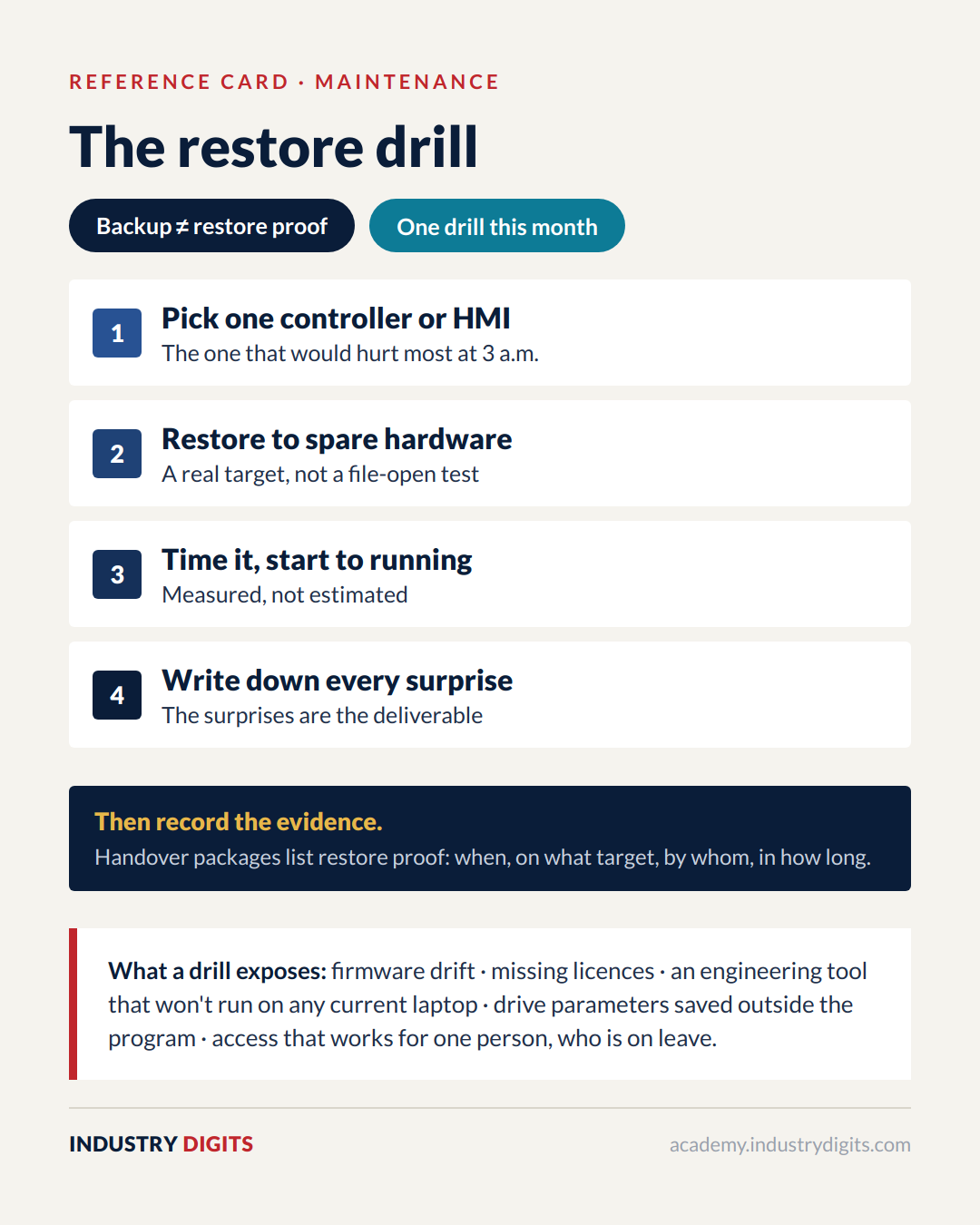
01 · The restore drill
Possession of a backup is not restore proof. Four steps to prove one, and the five failure modes only a drill exposes — firmware drift, missing licences, an engineering tool that won’t run on any current laptop, drive parameters saved outside the program, and access that works for one person who is on leave.
Download card 01 (PDF) · Pairs with Manual Loops, Backups, Spare I/O
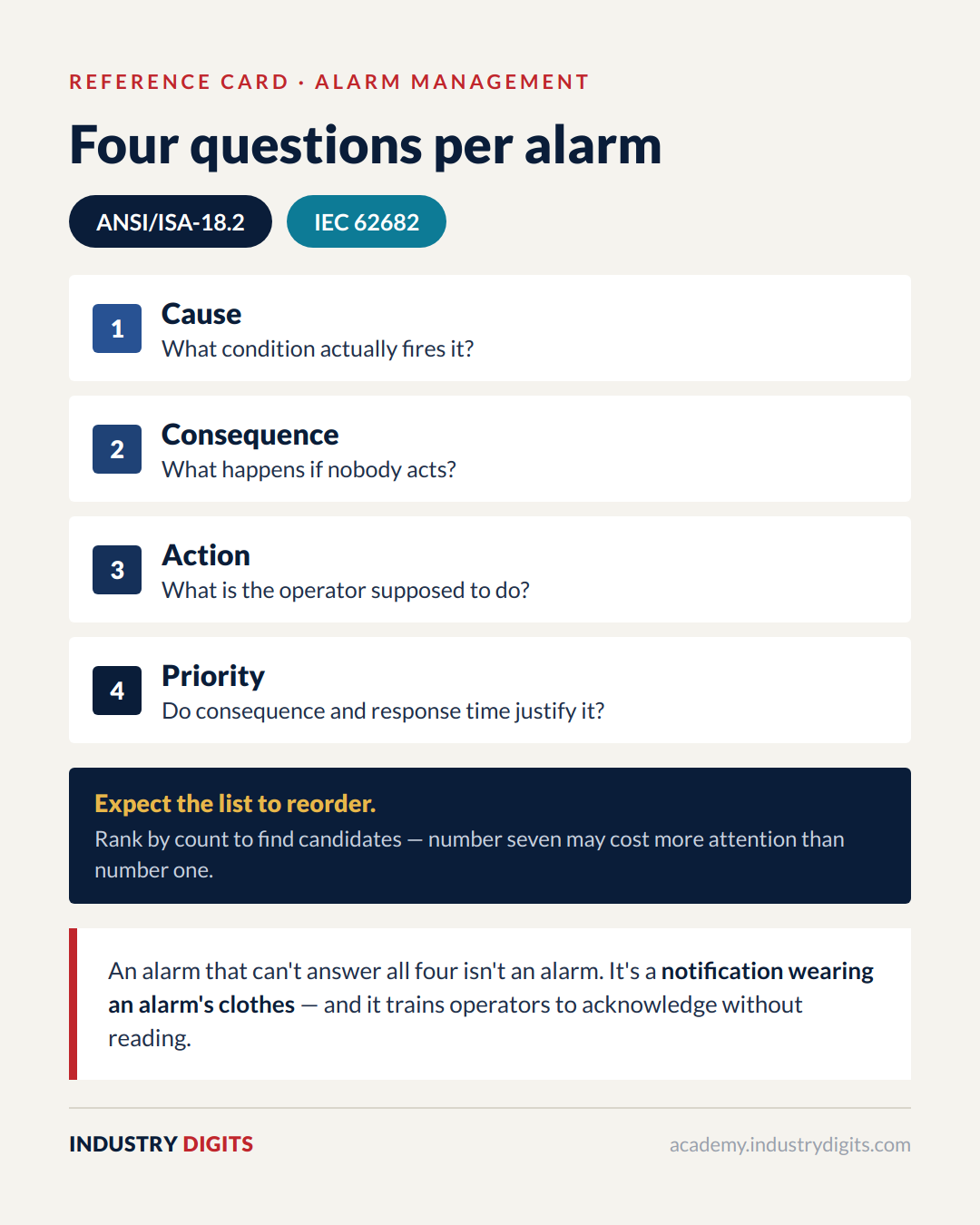
02 · Four questions per alarm
The ISA-18.2 rationalization questions — cause, consequence, action, priority. An alarm that cannot answer all four is a notification wearing an alarm’s clothes, and it trains operators to acknowledge without reading.
Download card 02 (PDF) · Pairs with The Alarm Nobody Owns and the Network Path Nobody Drew
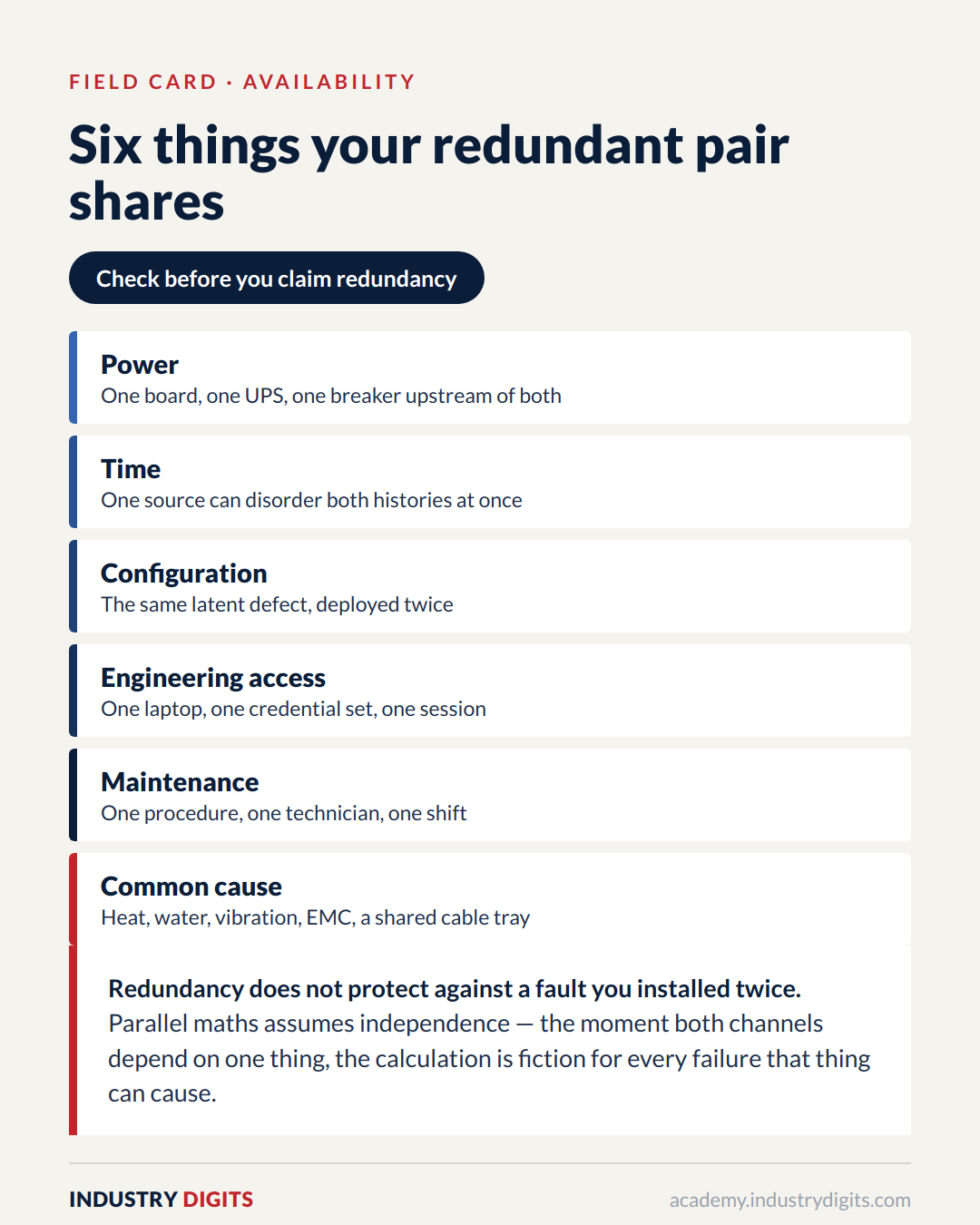
03 · Six things your redundant pair shares
Power, time, configuration, engineering access, maintenance practice, common cause. Run this before you defend any redundancy claim — parallel arithmetic assumes independence, and the moment both channels depend on one thing the calculation is fiction for every failure that thing can cause.
Download card 03 (PDF) · Pairs with Two Controllers, One UPS
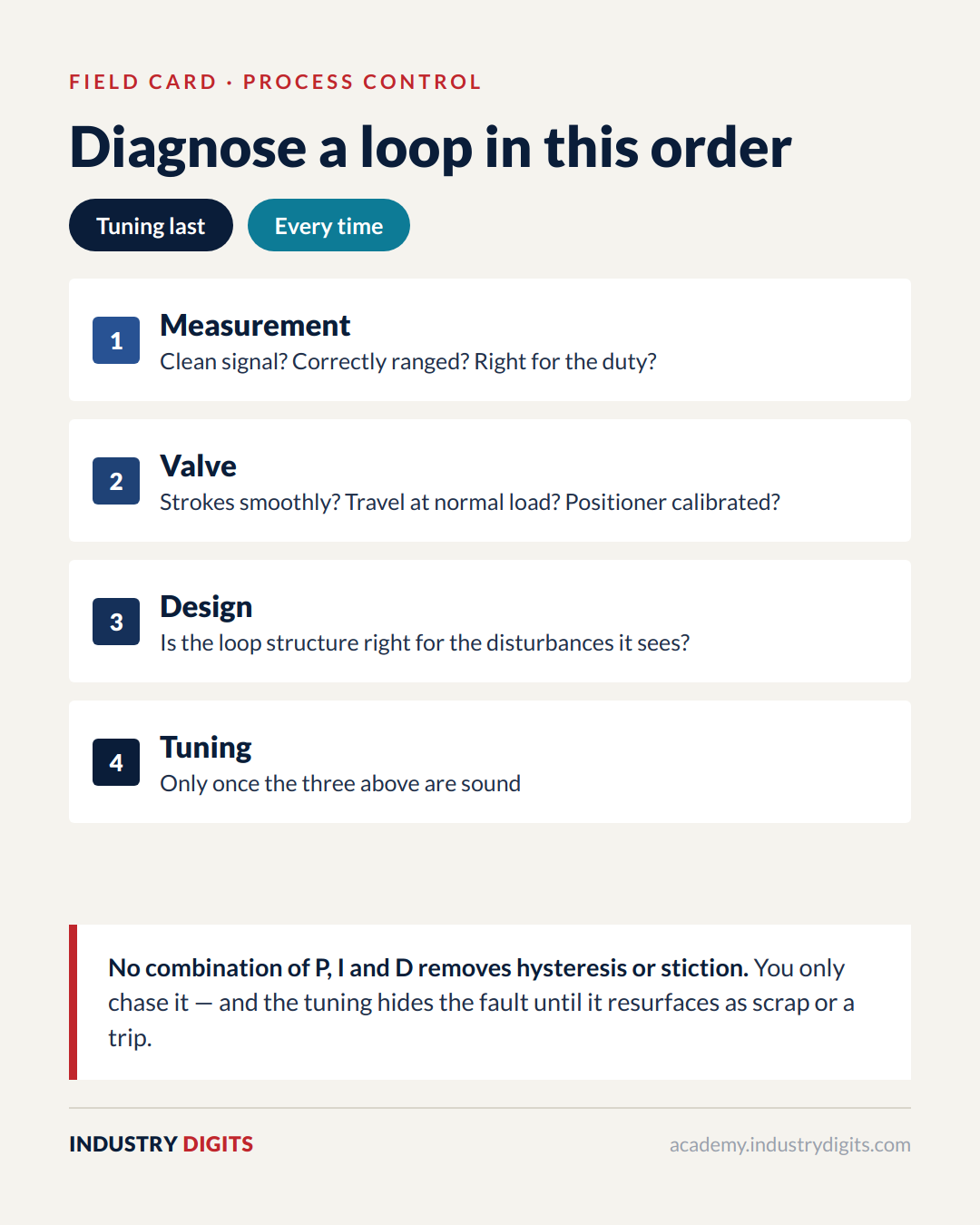
04 · Diagnose a loop in this order
Measurement, valve, design, tuning — tuning last, every time. No combination of P, I and D removes hysteresis or stiction; you only chase it, and the tuning hides the fault until it resurfaces as scrap or a trip.
Download card 04 (PDF) · Pairs with Manual Loops, Backups, Spare I/O
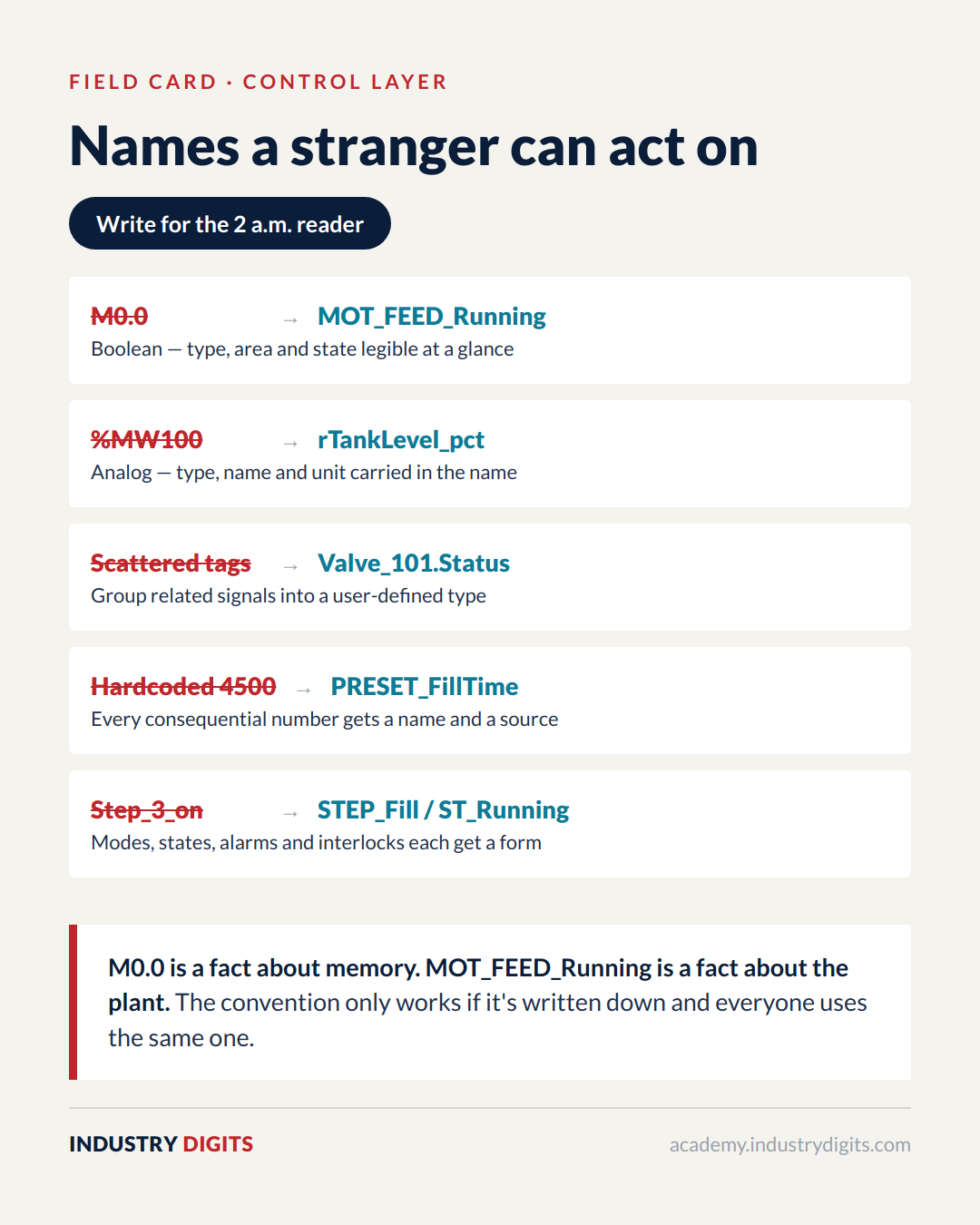
05 · Names a stranger can act on
Before and after, five pairs. M0.0 is a fact about memory; MOT_FEED_Running is a fact about the plant. The convention only works when it is written down and everyone uses the same one.
Download card 05 (PDF) · Pairs with What Unreadable PLC Code Costs You at 2 A.M.
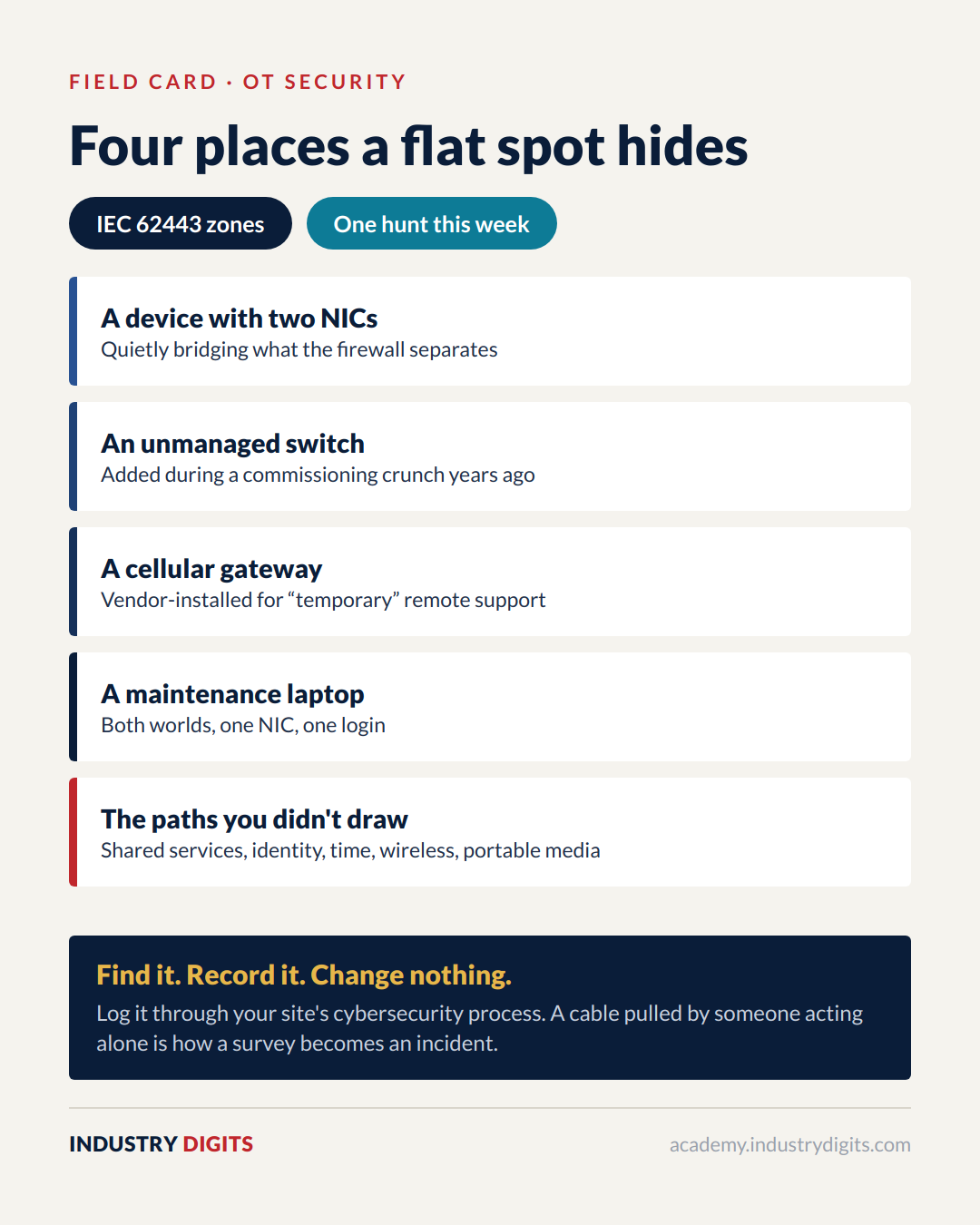
06 · Four places a flat spot hides
A device with two network cards, an unmanaged switch under a desk, a cellular gateway in a panel, a maintenance laptop crossing both worlds — plus the paths you didn’t draw at all. Find it, record it, change nothing.
Download card 06 (PDF) · Pairs with The Alarm Nobody Owns and the Network Path Nobody Drew
What these cards are, and what they aren’t
They are method: what to check, in what order, and what the finding means. They are deliberately not fillable forms or calculators.
The cards state the method and stop exactly where the tool would begin. Card 04 tells you to check valve travel — a working instrument is what logs it. Card 01 tells you to time the restore — a working instrument is what records the evidence.
Do the work by hand once using these cards. You will know very quickly whether the tooling is worth it to you.
Lokesh Chennuru writes Industry Digits field notes for industrial decision makers, focused on automation, IIoT, condition monitoring, predictive maintenance, and industrial AI.
Connect on LinkedInQuestions industrial leaders ask about this
Are the field cards free to download?
Yes. All six cards and the combined six-card PDF download directly with no signup, no email and no form. They are method references — what to check and in what order — and they are yours to print, post on a cabinet door or hand to a shift.
What is the difference between the field cards and the paid toolset?
The cards state the method and stop exactly where the tool would begin. Card 04 tells you to check valve travel; a working instrument is what logs it. Card 01 tells you to time the restore; a working instrument is what records the evidence. The cards are deliberately not fillable forms or calculators.
Which article does each card pair with?
Card 01 and 04 pair with the manual loops, backups and spare I/O audits. Cards 02 and 06 pair with the alarm and network-path article. Card 03 pairs with the redundancy article. Card 05 pairs with the PLC code maintainability article.
Industrial Automation — Real-World Frameworks & Implementation Guide
The ten-part guide this series draws on: project framing, system architecture, the field, control and supervisory layers, OT networks and cybersecurity, functional safety, integration, delivery and operations — with 28 technical figures and a 38-asset working pack.